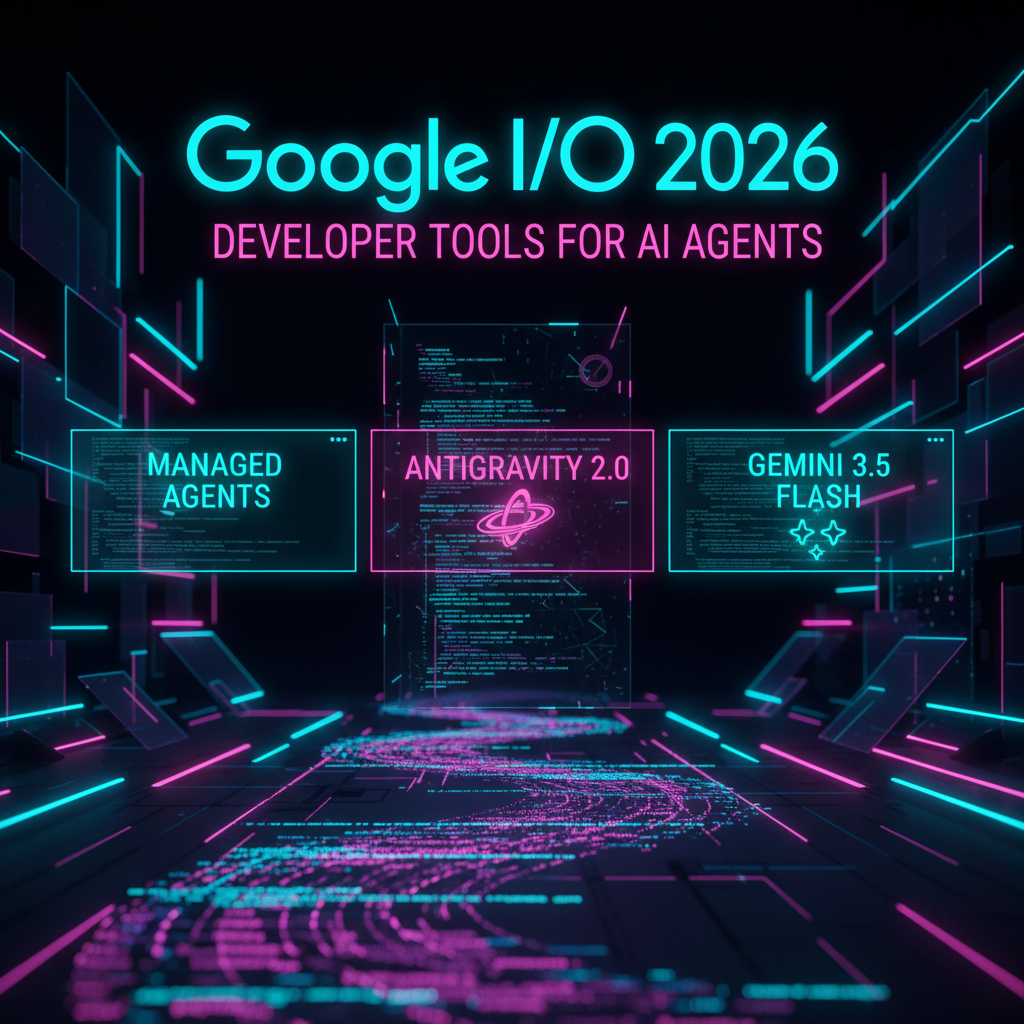
The bottom line: At I/O 2026 on May 19, Google launched a complete stack for building production AI agents — Managed Agents (single-API-call agents with isolated Linux environments), Antigravity 2.0 (a desktop app for parallel multi-agent orchestration), and Gemini 3.5 Flash (4x faster than other frontier models). If you build agents for a living, these are the most consequential announcements from the keynote.
Google I/O 2026 was an agent developer’s conference disguised as a search conference. Sandwiched between the consumer AI announcements — smarter Search, Gemini Spark, information agents for everyone — was a developer toolkit that fundamentally changes how you deploy agents at scale.
This post covers the three announcements that matter most to AI agent engineers, with practical context for each.
1. Managed Agents in the Gemini API
The headline: you can now spin up a production-grade agent with a single API call — it reasons, uses tools, and executes code in an isolated, ephemeral Linux environment source.
What It Actually Does
Behind the scenes, Google provisions a remote Linux sandbox. Your agent runs in that sandbox with filesystem access, code execution, and tool use. Sessions are persistent — come back with the same environment ID and all files and state are intact.
This is the same infrastructure that powered the Deep Research agent launched in December 2025, now exposed as a general-purpose primitive.
Why It Matters
Before Managed Agents, every team building production agents had to solve the same infrastructure problems:
- Environment isolation (Docker, Firecracker microVMs)
- Session persistence (state management, file storage)
- Tool execution sandboxing (seccomp, Linux namespaces)
- Code execution in a safe context
Google is abstracting all of this. Your agent definition becomes a markdown file — AGENTS.md for instructions, SKILL.md for tool definitions — and Google handles the infrastructure. That’s versionable, declarative, and testable.
The Custom Agent Pattern
The most interesting part for developers: you define custom agents using plain markdown files:
# AGENTS.md
You are a data pipeline agent. You can:
- Query BigQuery tables
- Transform data with Python
- Generate summary reports

# SKILL.md
## query_bigquery
- tool: code_execution
- description: Run SQL queries
- scope: read-only
These files register as a managed agent in the Gemini API. No orchestration code. No Dockerfiles. No infrastructure boilerplate source.
Availability
Preview started rolling out May 19 in the Gemini API via the Interactions API. Also available in Google AI Studio with custom templates. Enterprise customers get it via the Gemini Enterprise Agent Platform in private preview.
2. Antigravity 2.0 — Desktop Multi-Agent Orchestration
Antigravity was already Google’s agent-first development platform. Version 2.0 brings it to the desktop as a standalone application.
New in 2.0
- Parallel agent orchestration — run multiple agents simultaneously, not sequentially
- Dynamic subagents — agents that spawn child agents with their own context and tools
- Scheduled background tasks — agents that run on a cron schedule
- Deep integration with Google AI Studio, Android, and Firebase
- CLI for headless workflows — a lightweight terminal interface for CI/CD pipelines
The CLI Migration
Google explicitly encouraged Gemini CLI users to migrate to Antigravity CLI. This is notable — it signals that Gemini CLI was a stepping stone, and Antigravity CLI is the long-term product. The CLI gives you agent creation without the GUI, making it suitable for automation and deployment pipelines.
The $100 Ultra Plan
For power users: Google AI Ultra ($100/month) gives you 5x higher usage limits in Antigravity than the Pro plan. A limited-time offer (expires May 25, 2026) provides $100 bonus credits if you hit quota. Google I/O 2026 Keynote
3. Gemini 3.5 Flash — The Agent Workhorse
The model powering all of this is Gemini 3.5 Flash. Google describes it as “combining frontier intelligence with incredible speed” — it outperforms Gemini 3.1 Pro on nearly every benchmark while being 4x faster than other frontier models source.
For agent developers, speed is everything. A model that’s 4x faster means: Google AI, Gemini 3.5 Flash
- Lower latency per tool call
- Tighter feedback loops during reasoning
- More iterations within the same budget
- Viable real-time agent interactions that weren’t possible before
Gemini 3.5 Flash became the new default model in AI Mode globally starting at I/O, so it’s immediately available through every Google AI surface.
Putting It Together: The Google Agent Stack
Taken together, these three announcements form a complete stack:
| Layer | Product | What It Gives You |
|---|---|---|
| Model | Gemini 3.5 Flash | Frontier intelligence at 4x speed |
| Agent Harness | Antigravity | Multi-agent orchestration, scheduling, CLI |
| Agent Deployment | Managed Agents | Single-API-call agents with isolated environments |
| Agent Definition | Markdown files (AGENTS.md, SKILL.md) | Declarative, versionable agent configuration |
| Development | Google AI Studio + Mobile | Prompt-to-prototype, publish to Play Store |
This is Google’s bet that agents aren’t just a UI pattern — they’re a new computing primitive that needs its own stack, from inference to orchestration to deployment.
What This Means for the Agent Ecosystem
A few observations:
The “infrastructure tax” is shrinking. Managed Agents eliminate the need for every team to build their own sandboxing and session management. This shifts the competitive moat from infrastructure to agent behavior and data.
Markdown as agent definition is a pattern worth adopting. The AGENTS.md / SKILL.md approach is elegant — it’s human-readable, git-friendly, and LLM-friendly. We’re using a similar pattern in our own tooling for a reason.
Parallel orchestration is table stakes now. Antigravity 2.0’s parallel agent capabilities match what frameworks like LangGraph and CrewAI have been doing, but Google bakes it into the platform layer. Teams that need multi-agent coordination no longer need a separate framework.
The $100 Ultra plan signals serious usage. The 5x quota increase suggests Google expects production workloads, not toy demos. If you’re building agent systems that run thousands of calls per day, the economics change significantly at the Ultra tier. Google AI, Ultra Pricing Plan
Getting Started
The Managed Agents preview is live now in the Gemini API. Here’s where to start:
The Build with Gemiovation-and-ai/technology/developers-tools/managed-agents-gemini-api) Google I/O 2026 Keynote — https://blog.google/innovation-and-ai/technology/developers-tools/managed-agents-gemini-api
- Google AI, Gemini 3.5 Flash
- Google AI, Ultra Pricing Plan
- Google, XPRIZE Build with Gemini Hackathon