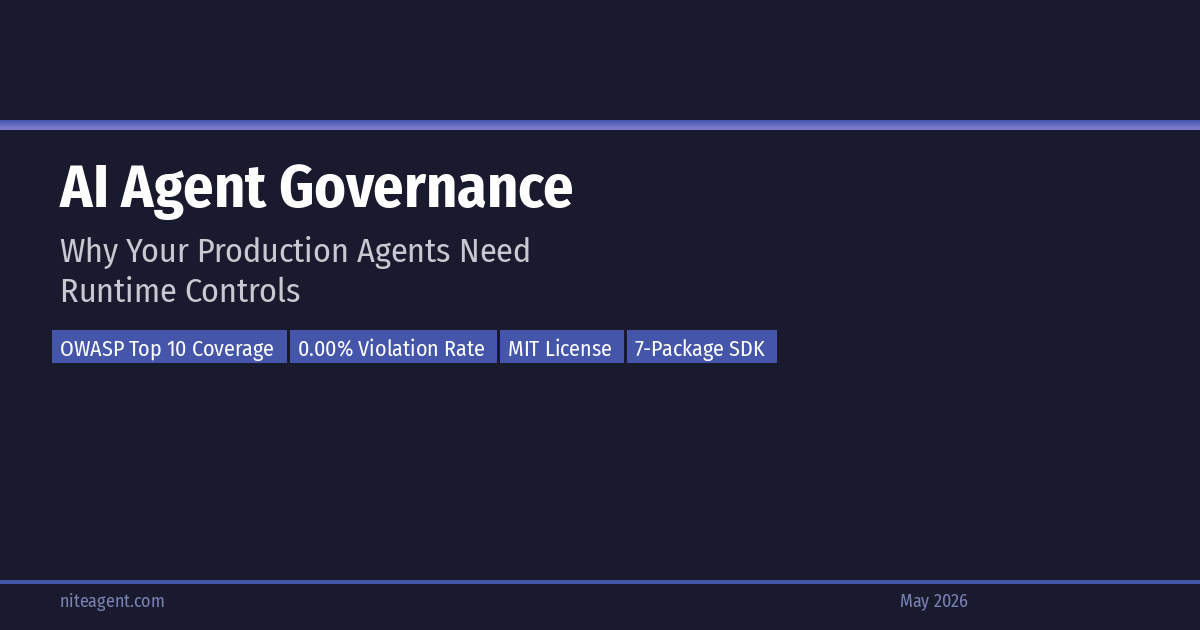
The bottom line: We’ve crossed the production threshold. LangChain’s State of Agent Engineering report found 57% of organizations have agents in production as of early 2026 source. But here’s the problem the builders are running into: prompt-based safety — telling agents to “follow the rules” — fails 26.67% of the time in red-team testing. Microsoft’s new Agent Governance Toolkit, which ships with an audited 0.00% violation rate, is the most important infrastructure change in agent development this year.
The Governance Gap
AI agents can now book travel, execute financial transactions, write and run code, and manage infrastructure without human intervention at each step. Frameworks like LangGraph, Claude Agent SDK, CrewAI, and AutoGen have made building autonomous agents straightforward.
The Alice Labs production-tested ranking — based on 18+ deployments — puts LangGraph at #1 for complex stateful workflows, Claude Agent SDK at #2 for Anthropic-native production agents, and CrewAI at #3 for fast multi-agent prototypes source. Each framework excels in different dimensions, but they all share one thing: none of them ship with built-in runtime governance.
The governance infrastructure to match agent autonomy has lagged behind. When an agent can call arbitrary tools, execute code, and make API calls on your behalf, a system prompt saying “be careful” isn’t a control — it’s a suggestion.
Enter the Agent Governance Toolkit
On April 2, 2026, Microsoft released the Agent Governance Toolkit (AGT) as an MIT-licensed open-source project source. It’s a seven-package system available in Python, TypeScript, Rust, Go, and .NET — each package addressing a distinct layer of agent governance.
The architecture is brutally simple at the top level:
Agent Action → Policy Check → Allow / Deny → Audit Log (< 0.1 ms)This isn’t another prompt-injection detector. It’s deterministic, sub-millisecond policy enforcement that intercepts every agent action before it executes. The policy engine benchmarks at 0.012ms p50 for a single rule and 35,000 ops/sec concurrent throughput.
What’s in the Toolkit
Policy Engine (Agent OS)
The policy engine supports YAML, OPA/Rego, and Cedar policy languages. It’s fail-closed by default — if the engine errors, the action is denied. You define policies like:
rules:
  - action: "execute_code"
    allow: false
  - action: "http_request"
    allow: true
    domains: ["api.example.com"]
    methods: ["GET"]
This is the same philosophy as Kubernetes admission controllers or service mesh authorization — except applied at the agent action level rather than the network level.
Zero-Trust Identity (Agent Mesh)
Every agent gets a cryptographic identity using decentralized identifiers with Ed25519 signing (plus quantum-safe ML-DSA-65). The Inter-Agent Trust Protocol (IATP) handles agent-to-agent communication with dynamic trust scoring on a 0–1000 scale across five behavioral tiers.
If an agent starts acting outside its expected patterns, its trust score decays. Trust ceilings propagate through delegation chains — a tool-calling agent cannot escalate privileges beyond what its parent agent was granted.
Execution Sandboxing
Four privilege rings modeled after hardware isolation: kernel, supervisor, user, untrusted. Combined with saga orchestration for multi-step workflows — if step 3 of 7 fails, automatic compensation rolls back steps 1 and 2. A kill switch enables immediate agent termination with zero additional work when policy violations occur.
This is closer to an operating system model than a traditional middleware layer.
MCP Security Gateway
One of the most practical features: tool poisoning detection, description drift monitoring, typosquatting checks, and hidden instruction scanning for MCP servers. As MCP becomes the standard protocol for agent-tool communication, the security gateway catches malicious or compromised tools before the agent uses them.
Framework Integration — No Rewrites Required
The toolkit is designed to work alongside existing agent frameworks through native extension points:
- LangChain: callback handlers
- CrewAI: task decorators
- Google ADK: plugin system
- Microsoft Agent Framework: middleware pipeline
- OpenAI Agents SDK, LangGraph, PydanticAI: published on PyPI
- LlamaIndex: TrustedAgentWorker integration
- Haystack: merged upstream
This means you can add governance to an existing LangGraph deployment without changing your agent logic — the policy engine sits between the agent’s decision and execution.
OWASP Coverage — Why It Matters
December 2025 saw OWASP publish the first formal taxonomy of agentic AI risks: the Top 10 for Agentic Applications 2026 source. The risks include goal hijacking, tool misuse, identity abuse, memory poisoning, cascading failures, and rogue agents.
AGT maps to all 10 categories. The semantic intent classifier counters goal hijacking at the policy engine level. Cross-model verification kernel with majority voting addresses memory poisoning. Ring isolation, trust decay, and the automated kill switch target rogue agent behavior.
The project ships with 9,500+ tests across all packages, uses ClusterFuzzLite for continuous fuzzing, and includes SLSA-compatible provenance, OpenSSF Scorecard tracking, and CodeQL scanning in its build pipeline.
The Production-Ready Stack in 2026
What this means for developers: the modern agent stack now has three layers.
The orchestration layer — LangGraph, Claude Agent SDK, or CrewAI for agent logic, state management, and multi-agent coordination.
The tool layer — MCP servers, REST APIs, and code execution environments that agents interact with.
The governance layer — AGT (or equivalents) for policy enforcement, identity, audit, and sandboxing between the orchestration and tool layers.
Teams that skip the governance layer are running agents with the equivalent of allow-all firewall rules. It works until it doesn’t — and when it fails, the blast radius includes production data, external API billing, and compliance exposure.
Getting Started
pip install agent-governance-toolkit[full]For TypeScript projects:
npm install @microsoft/agent-governance-sdkThen add a policy file, hook it into your agent framework’s extension point via the provided adapter, and the governance layer starts intercepting actions immediately.
Microsoft has stated it intends to move the project to a foundation for community governance and is engaging with the OWASP agentic AI community to facilitate the transition source. For now, it’s available under MIT on GitHub.
What’s Next
The agent governance space is moving fast. Multiple tools are competing for this layer — systemprompt.io, AvePoint AgentPulse, and several others — but Microsoft’s entry is significant because it’s framework-agnostic, open-source, and backed by the OWASP taxonomy it directly implements.
For teams already running agents in production: the governance gap is the highest-risk surface in your stack. For teams still building: don’t ship without it. The era of “just prompt it safely” is over.
oft.com/blog/2026/04/02/introducing-the-agent-governance-toolkit-open-source-runtime-security-for-ai-agents/) source
← Back to all posts