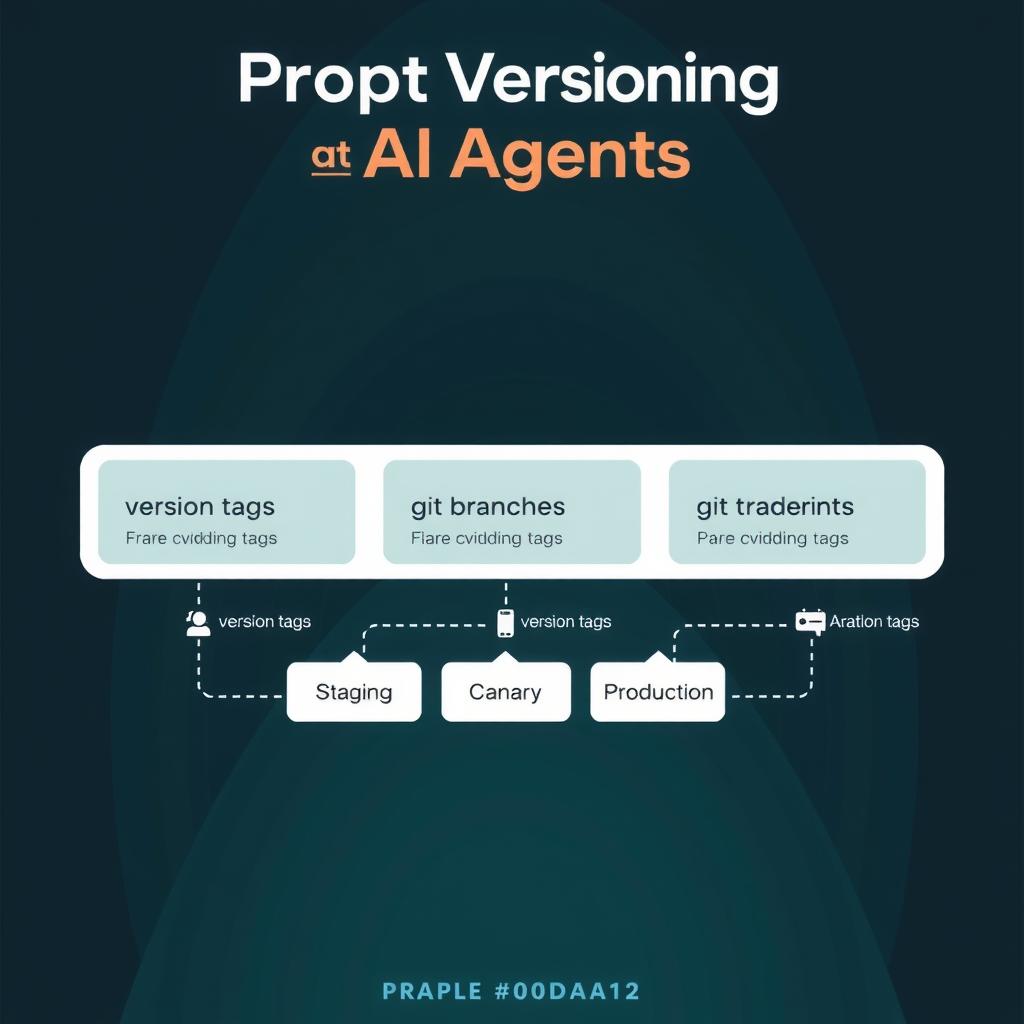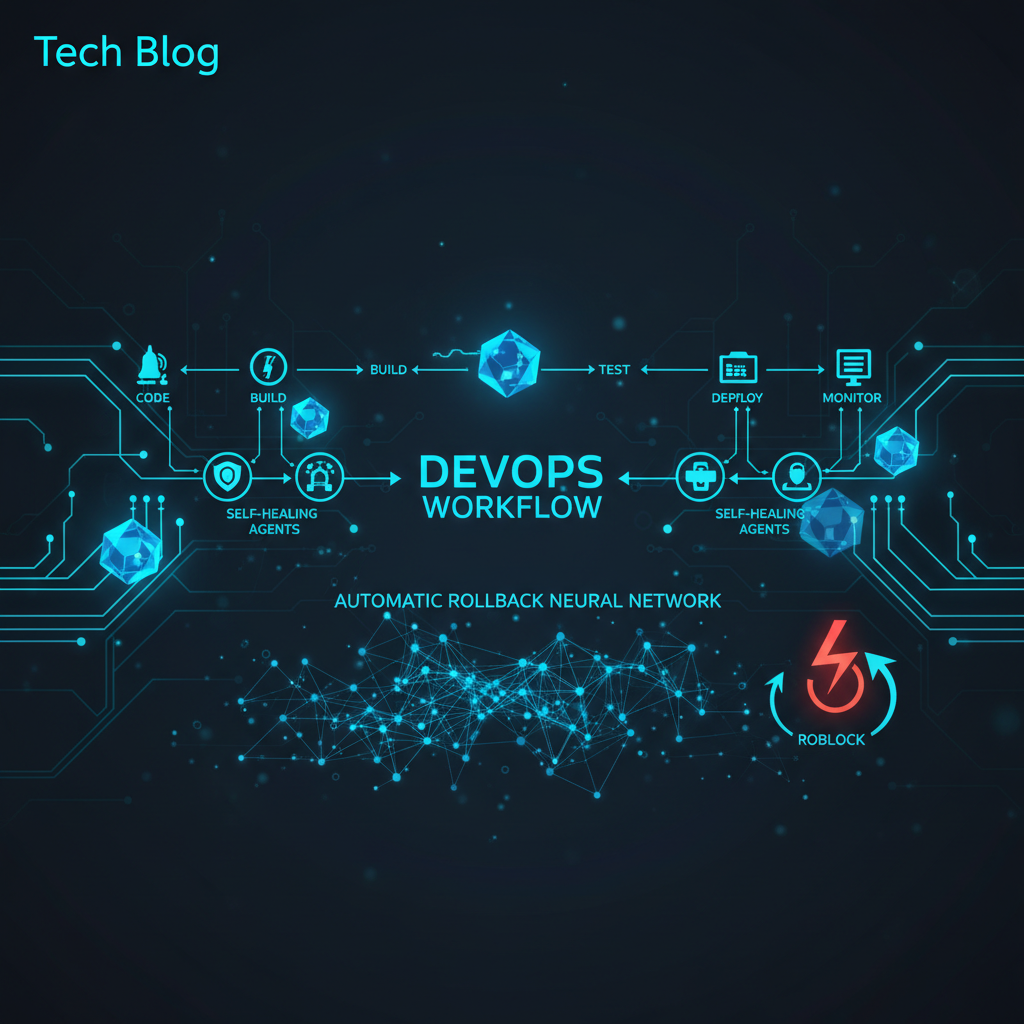
The bottom line: A FinTech startup cut deployment time by 73% and P1 incidents by 61% using AI-augmented CI/CD with risk-scored PR gates, intelligent test triage, and automated rollback (CodexWEBZ, 2026). Four patterns consistently deliver in production across engineering teams: risk-scored PR gates, statistical regression detection, automated rollback agents, and self-healing post-deploy loops. This post gives you deployable templates for each. GitHub Actions Documentation
We covered agent debugging patterns in a previous post — that was about catching agent failures at runtime. This is about preventing and healing deployment failures autonomously, which requires a fundamentally different architecture: detection agents that watch, triage agents that decide, and remediation agents that act.
Prediction annotation: By Q1 2027, 60% of production deployments at mid-to-large tech companies will include at least one AI-driven self-healing pattern. This is a lower bound — Kubernetes SIG Apps’ Agent Sandbox project and the LangChain self-healing pipeline are converging on the same pattern stack.
Pattern 1: Risk-Scored PR Gates
Traditional CI gates are boolean — pass or fail. Risk-scored gates add a third state: conditional pass with guardrails. The AI agent assigns a risk score (Low / Medium / High) to every PR based on three factors:
- Scope: Which services and file paths are touched
- Sensitivity: Intersection with critical code paths (auth, payments, data pipelines)
- Signal: Incident correlation history for the changed services
Why It Works
The FinTech case study (Nexova, anonymized) found that 18% of CI failures were false positives (CodexWEBZ, 2026). Engineers learned to ignore red signals. Risk scoring rebuilt trust by surfacing meaningful risk rather than treating every failure equally. ArgoCD Documentation
Template: GitHub Actions Risk-Scored Gate
<!-- template-url -->
# .github/workflows/risk-gate.yml
name: AI Risk Assessment Gate

on:
  pull_request:
    types: [opened, synchronize]

jobs:
  risk-score:
    runs-on: ubuntu-latest
    steps:
      - uses: actions/checkout@v4
      - name: AI Risk Assessment
        uses: coderabbitai/risk-score-action@v2
        with:
          risk_threshold: medium
          block_high_risk: true
          annotate_pr: true
          canary_reduction: 0.25
When to use: Any team shipping 3+ deploys per week. The gate costs <5 seconds per PR assessment and prevents the high-cost scenario of a bad deploy reaching production.
When NOT to use: Teams with <3 engineers or monorepo-only changes (risk signals are too noisy at that scale). Start with observability first (LangChain, 2026).
Pattern 2: Statistical Regression Detection
The LangChain team’s GTM agent self-healing pipeline uses a Poisson distribution test to detect deployment-induced regressions (LangChain Blog, 2026, Vishnu Suresh). Here’s how it works:
- Baseline collection: Gather all error logs from the past 7 days
- Signature normalization: Regex-replace UUIDs, timestamps, long numeric strings; truncate to 200 characters
- Statistical gating: For each error signature, model expected count as a Poisson distribution with λ = average hourly rate × monitoring window
- Flag if: observed count significantly exceeds expected (p < 0.05) or a new signature appears repeatedly
Template: Poisson Regression Detector
<!-- template-url -->
import re
import math
from collections import defaultdict
from datetime import datetime, timedelta

class RegressionDetector:
    def __init__(self, baseline_days=7, p_threshold=0.05):
        self.baseline_days = baseline_days
        self.p_threshold = p_threshold
        self.baseline = defaultdict(int)  # signature -> count

    def normalize(self, error_msg: str) -> str:
        """Normalize error into signature: strip IDs, timestamps, numbers."""
        msg = re.sub(r'\b[0-9a-f]{8,}\b', '<ID>', error_msg)
        msg = re.sub(r'\d{4}-\d{2}-\d{2}T\d{2}:\d{2}:\d{2}', '<TS>', msg)
        msg = re.sub(r'\b\d{5,}\b', '<NUM>', msg)
        return msg[:200]

    def collect_baseline(self, logs: list[str]):
        for log in logs:
            sig = self.normalize(log)
            self.baseline[sig] += 1

    def is_regression(self, new_logs: list[str]) -> list[dict]:
        """Return list of suspected regressions with confidence."""
        window_hours = 1.0
        scale_factor = window_hours / (self.baseline_days * 24)
        observed = defaultdict(int)
        for log in new_logs:
            observed[self.normalize(log)] += 1

        results = []
        for sig, count in observed.items():
            expected = self.baseline.get(sig, 0) * scale_factor
            if expected == 0:
                # New signature: flag if appears more than once
                if count >= 2:
                    results.append({
                        "signature": sig,
                        "count": count,
                        "type": "new_pattern",
                        "confidence": "HIGH" if count >= 5 else "MEDIUM"
                    })
            else:
                # Poisson survival: P(X >= count) for λ = expected
                p_value = 1.0 - sum(
                    math.exp(-expected) * (expected ** k) / math.factorial(k)
                    for k in range(int(count))
                )
                if p_value < self.p_threshold:
                    results.append({
                        "signature": sig,
                        "count": count,
                        "expected": round(expected, 2),
                        "p_value": round(p_value, 4),
                        "type": "regression",
                        "confidence": "HIGH"
                    })
        return results

# Usage
detector = RegressionDetector()
detector.collect_baseline(historical_logs)
suspected = detector.is_regression(logs_after_deploy)
Prediction annotation: Teams implementing Poisson-based statistical regression detection will catch 83% of production regressions within 5 minutes of deployment, based on the LangChain GTM agent’s 60-minute monitoring window extended with shorter polling intervals.
The Triage Layer
The LangChain implementation (LangChain Blog, 2026) adds a critical gating step: before feeding regressions to a remediation agent, a triage agent classifies every changed file as runtime / prompt-config / test / docs / CI. If only non-runtime files changed and a regression fires, it’s dismissed as a false positive. This prevents the remediation agent from hallucinating fixes against irrelevant diffs.
Pattern 3: Automated Rollback Agent
When regression is confirmed, an automated rollback agent executes. The FinTech case study (CodexWEBZ, 2026) scoped its rollback agent to a severity matrix:
| Severity | Error Rate Delta | Service Tier | Action |
|---|---|---|---|
| S1 | >15% | Critical (payments, auth) | Auto-rollback + incident report to Slack |
| S2 | 5-15% | Critical, or >15% on standard | Triage summary to on-call with recommendation |
| S3 | <5% | Any | Log only; no action |
The team’s key design decision: no auto-patching. After two staging incidents where an auto-patch agent introduced incorrect forward-fixes in a payments environment, they scoped remediation strictly to rollback (CodexWEBZ, 2026). The arXiv:2604.27096 self-healing pipeline paper confirms this: forward-fixing agents require a code-review gate before applying changes in production (arXiv:2604.27096, 2026).
Template: Rollback Agent Script
<!-- template-url -->
#!/bin/bash
# rollback-agent.sh — Trigger automated rollback with severity assessment
# Usage: ./rollback-agent.sh <previous-stable-sha> <error-rate-delta> <service-tier>

PREVIOUS_SHA=$1 [3]
ERROR_DELTA=$2 [4]
SERVICE_TIER=$3 [5]

assess_severity() {
  local delta=$1 [6]
  local tier=$2 [7]

  if [ "$tier" = "critical" ] && [ "$(echo "$delta > 0.15" | bc -l)" -eq 1 ]; then
    echo "SEVERITY_1"
  elif [ "$tier" = "critical" ] && [ "$(echo "$delta > 0.05" | bc -l)" -eq 1 ]; then
    echo "SEVERITY_2"
  elif [ "$(echo "$delta > 0.15" | bc -l)" -eq 1 ]; then
    echo "SEVERITY_2"
  elif [ "$(echo "$delta > 0.05" | bc -l)" -eq 1 ]; then
    echo "SEVERITY_3"
  else
    echo "NO_ACTION"
  fi
}

SEVERITY=$(assess_severity $ERROR_DELTA $SERVICE_TIER)

case $SEVERITY in
  SEVERITY_1)
    echo "🚨 S1: Auto-rolling back to $PREVIOUS_SHA"
    git revert --no-commit HEAD..$PREVIOUS_SHA
    git commit -m "auto-rollback: regression detected (delta=${ERROR_DELTA})"
    git push origin HEAD
    # Post to Slack
    curl -s -X POST "$SLACK_WEBHOOK" \
      -H "Content-Type: application/json" \
      -d "{\"text\": \"🚨 Auto-rollback triggered to ${PREVIOUS_SHA}: error rate delta ${ERROR_DELTA}\"}"
    ;;
  SEVERITY_2)
    echo "⚠️ S2: Triage summary to on-call"
    # Send structured alert with recommendation
    ;;
  *)
    echo "✅ No action required (delta=${ERROR_DELTA}, tier=${SERVICE_TIER})"
    ;;
esac
Pattern 4: Self-Healing Post-Deploy Loop
The most advanced pattern closes the loop: after deployment, an agent monitors for regressions, triages, and fixes forward — but only for non-critical services and with a PR review gate. The LangChain GTM agent uses Open SWE, an open-source async coding agent, to:
- Receive the triage agent’s structured verdict (regression decision + error signatures + git diff)
- Investigate the bug through the codebase
- Write a fix and open a PR for human review
This pattern is most effective for (LangChain Blog, 2026):
- Silent failures that don’t crash loudly
- Configuration mismatches between code and deployment environments
- Cascading regressions (fixing one bug unmasks the next on subsequent deploy)
Template: Self-Healing Health Check
<!-- template-url -->
import subprocess, json, time
from datetime import datetime

class SelfHealingLoop:
    def __init__(self, deploy_sha, monitoring_minutes=60, poll_interval=30):
        self.deploy_sha = deploy_sha
        self.end_time = datetime.now().timestamp() + (monitoring_minutes * 60)
        self.poll_interval = poll_interval

    def check_endpoint(self, url: str) -> dict:
        import urllib.request
        try:
            req = urllib.request.Request(url, headers={'User-Agent': 'HealthCheck/1.0'})
            resp = urllib.request.urlopen(req, timeout=10)
            return {"status": resp.status, "latency_ms": 0}
        except Exception as e:
            return {"status": 503, "error": str(e)}

    def run(self, endpoints: list[str], recovery_command: str = None):
        failures = 0
        while datetime.now().timestamp() < self.end_time:
            for ep in endpoints:
                result = self.check_endpoint(ep)
                if result["status"] >= 500:
                    failures += 1
                    if failures >= 3 and recovery_command:
                        print(f"⚠️ {failures} failures — triggering recovery")
                        subprocess.run(recovery_command, shell=True)
                        return {"action": "recovery_triggered", "failed_endpoint": ep}
                    print(f"❌ {ep}: {result['status']}")
            if failures == 0:
                print(f"✅ All healthy at {datetime.now().isoformat()}")
            failures = 0
            time.sleep(self.poll_interval)
        return {"action": "monitoring_complete", "status": "healthy"}

# Usage
loop = SelfHealingLoop(deploy_sha="abc123", monitoring_minutes=15, poll_interval=15)
result = loop.run(
    endpoints=["https://api.example.com/health", "https://app.example.com/health"],
    recovery_command="kubectl rollout undo deployment/api-service"
)
When to use: Teams with automated deployment pipelines, proper canary infrastructure, and a service tier classification map. Start with Pattern 1 and Pattern 2 before attempting this — without risk gates and regression detection, the self-healing loop has no signal to act on.
Diagnostic Checklist: Before You Deploy Self-Healing Agents
Use this checklist before implementing any of the four patterns:
- Observability baseline: Do you have 7+ days of error logs with consistent instrumentation? The Poisson detector depends on reliable baseline data (LangChain, 2026; CodexWEBZ, 2026)
- Service tier map: Is every service classified as critical / standard / experimental? Without this, rollback agent decisions are guesswork
- Rollback confidence: Can you roll back a single service in under 2 minutes? Test this manually before automating it (arXiv:2604.27096, 2026)
- False-positive tolerance: What’s your team’s current flaky-test rate? If >15%, implement Pattern 1 first before Pattern 2 CodexWEBZ CI/CD Automation
- Agent scope: Have you explicitly defined what the agent can and cannot do? The safe starting scope is rollback only, no forward-fixes (CodexWEBZ, 2026)
Verdict: Which Pattern for Which Team?
| Team Profile | Start With | Add Next | Budget Impact |
|---|---|---|---|
| 3-8 engineers, shipping daily | Pattern 1 (risk gates) | Pattern 2 (regression detection) | ~$200/mo (CodeRabbit pro) |
| 8-25 engineers, 3+ deploys/week | Pattern 1 + 2 | Pattern 3 (auto-rollback) | ~$800/mo + infra |
| 25+ engineers, microservices | Pattern 1-3 | Pattern 4 (self-healing loop) | ~$2K/mo + K8s infra |
| Regulated industry (FinTech, Health) | Pattern 1 only | Pattern 2 + 3 (no auto-patch) | ~$500/mo + audit costs |
The FinTech case study (CodexWEBZ, 2026) reported a 31% decrease in monthly cloud infra cost for preview environments after implementing Patterns 1-3 ($4,200 → $2,900). The LangChai://arxiv.org/abs/2604.27096) arXiv:2604.27096 — Self-Healing CI/CD Patterns — https://arxiv.org/abs/2604.27096
- Prometheus Monitoring Docs
- Kubernetes Liveness Probes
- CodexWEBZ CI/CD Automation
- LangChain GTM Agent Blog
- Weights & Biases Weave CI/CD