TL;DR: AI agents fail differently than apps — plausible wrong answers, infinite tool loops, silent task failures. Standard monitoring (uptime, latency, error rates) catches none of it. This guide covers the 5 signals that actually matter, the observability stack that works in 2026, and how to integrate agent monitoring into your CI/CD pipeline.
Why Traditional Monitoring Breaks for AI Agents
“Agentic systems fail in ways that look like success.” — Arize AI, 2026
Traditional monitoring tracks server health and HTTP status codes. It tells you a container is running. It does not tell you that your customer support agent answered a billing question using the wrong database, that your scheduling agent spent 800 tokens looping between two tools, or that your incident triage agent skipped a critical step.
The error lives in reasoning, not code execution. An agent can:
- Return a plausible but incorrect answer using the right tools in the wrong order
- Burn tokens in a recursive loop between two tool calls, costing $10/hour silently Arize AI, Best AI Observability Tools 2026
- Skip a step in a multi-agent handoff, leaving a task incomplete
- Trigger a cascading failure where one hallucinated tool argument corrupts downstream agents
None of these surface as server errors. They surface as customer complaints, ballooning cloud bills, and angry posts on social media.
The 5 Signals That Actually Matter in 2026
| Signal | What It Catches | Example Trigger |
|---|---|---|
| Tool Selection Accuracy | Wrong tool used for task | Billing agent queries product DB instead of billing DB |
| Task Completion Rate | Silent failures, skipped steps | Incident triage agent “completes” without assigning owner |
| Recursive Loop Detection | Token waste, infinite cycles | Same 3 tool calls repeated 12 times in 2 minutes |
| Cost Per Successful Output | Efficiency drift | Cost jumps 30% week-over-week for same workflow |
| Hallucination Rate | Plausible wrong answers | Output cites nonexistent customer IDs or order numbers |
Why “Prompt Success Rate” Isn’t Enough
A prompt can return a grammatically polished, confidently wrong answer. Semantic evaluation — checking whether the intent of the output matches the expected outcome — is the minimum bar for agent observability in 2026 Arize AI, Best AI Observability Tools 2026.
The 2026 Observability Stack
Layer 1: OpenTelemetry (Foundation)
The CNCF OpenTelemetry standard now has AI-specific semantic conventions (2025+). It gives you vendor-neutral instrumentation that works with any downstream tool.
# Minimal OTel instrumentation for an agent
from opentelemetry import trace
tracer = trace.get_tracer("agent.observability")

with tracer.start_as_current_span("agent.run") as span:
    span.set_attribute("agent.task", "process_refund")
    # Agent logic here
    span.set_attribute("agent.tools_called", tool_count)
    span.set_attribute("agent.completion_status", "success" if ok else "failed")
Layer 2: Agent Trace Store
Raw telemetry needs analysis. In 2026, the major players are:
| Tool | Best For | Architecture | Evaluation |
|---|---|---|---|
| Arize AX | Enterprise scale | SDK (agent continues if observability goes down) | Luna-2 LLM-as-judge evals |
| Braintrust | Eval-first engineering | SDK + OLAP (Brainstore) for queryable traces | Auto-evaluators + Loop AI |
| LangSmith | LangChain/CrewAI ecosystems | SDK, tight framework coupling | LangChain-specific evaluators |
| Langfuse | Open-source self-hosting | SDK, Clickhouse-backed | Prompt-level scoring |
| Datadog LLM Obs | Existing Datadog shops | APM extension, proxy-based | Correlates with infra metrics |
| Galileo | Safety & compliance | SDK (eval logic in platform, no inference latency) | Proprietary evaluation models |
Rule of thumb: If you own your infrastructure, start with OpenTelemetry + Arize Phoenix (open source) or Langfuse. For teams all-in on LangChain, LangSmith is friction-free. For enterprise compliance, Galileo’s SDK-based safety eval layer is hard to beat.
Layer 3: Decision Graph Visualization
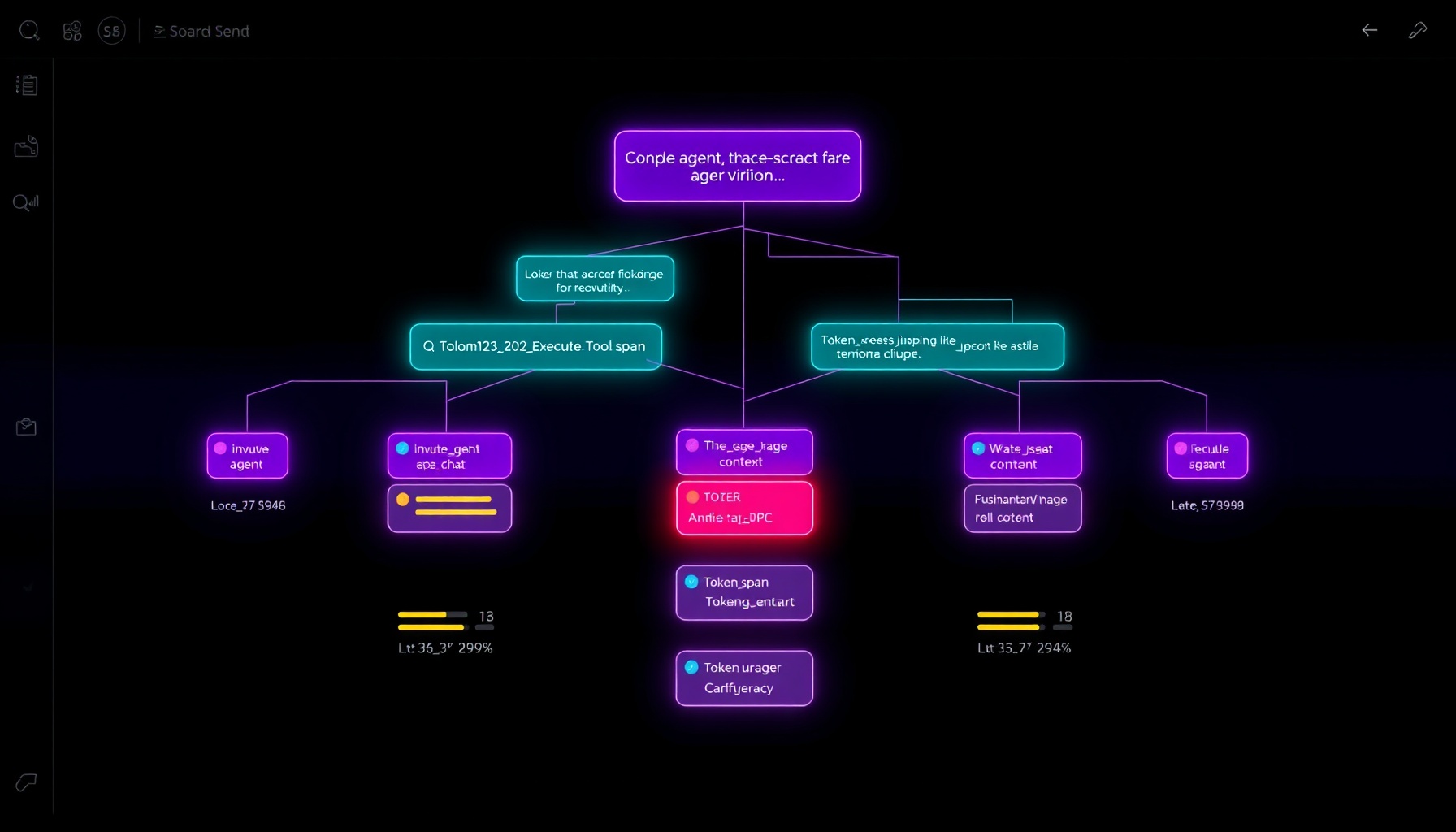
Raw traces are useless without structure. The leading tools render an Agent Decision Graph — an execution tree showing every delegation, tool call, and state change. This makes debugging agent loops faster than scrolling through JSON logs Arize AI, Best AI Observability Tools 2026.
Arize’s Agent Graph and Braintrust’s trajectory maps both auto-detect:
- Recursive loops (same tool arguments repeated)
- Wasted tokens (tool calls that return no actionable data)
- Cascade failures (one bad output corrupts 5 downstream agents)
Integrating Agent Observability Into CI/CD
The most important shift in 2026: observation isn’t reactive anymore. Teams now run evaluation suites in CI:
# .github/workflows/agent-eval.yml (conceptual)
on: [deployment]
jobs:
  eval:
    runs-on: ubuntu-latest
    steps:
      - run: trigger 50 predefined agent scenarios against staging
      - run: compare outputs to baseline embeddings
      - run: halt if >5% semantic drift detected [1]
      - run: fail if hallucination rate > 2% [2]
Microsoft’s Azure AI Foundry and Datadog LLM Observability both support this pattern natively. Langfuse’s prompt-scoring API lets you capture and replay production traces as regression tests with a single click.
Safety & Compliance Guardrails
Agents in production need behavioral guardrails beyond traditional monitoring:
- PII/PHI scanning on every agent output before delivery
- Off-policy detection — catch actions that violate business rules
- Human-in-the-loop thresholds — escalate when confidence drops below threshold Arize AI, Best AI Observability Tools 2026
- Audit trails — every decision logged with context for compliance
The EU AI Act (effective August 2026) and state-level AI regulations in the US make this mandatory for enterprise deployments. Tools like Galileo and Arize AX now include regulatory compliance modules that map agent traces to specific regulatory requirements.
Production Anti-Patterns to Avoid
| Anti-Pattern | Why It’s Dangerous | Fix |
|---|---|---|
| Black-box deployment | No visibility until users complain | Instrument OTel from day 0 |
| Framework-coupled monitoring | Switching frameworks loses all traces | Use OTel + framework-agnostic tool |
| Threshold-free alerting | Every deviation fires an alert | Set dynamic baselines per agent type |
| No human-in-the-loop | Autonomous agents make irreversible errors | Set escalation thresholds per workflow |
| Ignoring cost signals | Agent loops burn budget silently | Alert on cost-per-task spikes |
Getting Started Today
- Instrument with OpenTelemetry — add spans for every tool call, decision point, and handoff
- Set baseline metrics — run 50 eval scenarios, capture latency/accuracy/cost distributions
- Pick a trace store — Langfuse for quick start, Arize or Braintrust for production scale
- Build a decision graph dashboard — your primary debugging surface
- Wire e eval into CI/CD — halt deployments on semantic drift
No agent should ship without observability. In 2026, that’s a hard requirement for any team running agents in production.
Sources: [Arces-tools-and-metrics/), Braintrust, AI Observability Tools Buyer’s Guide 2026 Braintrust — AI Observability Tools Buyer’s Guide 2026, OpenTelemetry AI Semantic Conventions OpenTelemetry AI Semantic Conventions
References
- Arize AI, Best AI Observability Tools 2026
- UptimeRobot, AI Agent Monitoring Best Practices
- Braintrust, AI Observability Tools Buyer’s Guide 2026
- OpenTelemetry AI Semantic Conventions
📖 Related Reads
- ToolBrain — tool reviews, LLM comparisons, and AI workflow guides
Cross-links automatically generated from NiteAgent.
← Back to all posts