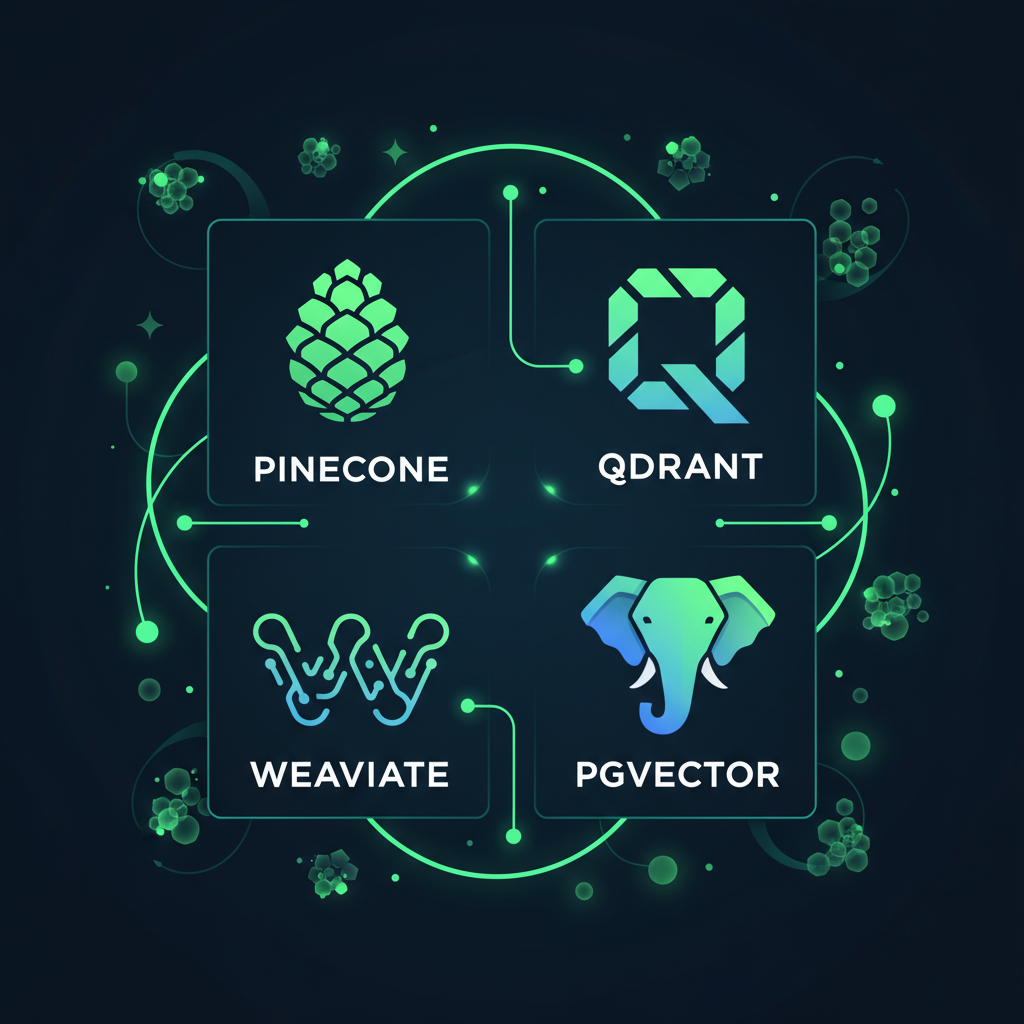
The bottom line: Every RAG pipeline needs a vector store, but the wrong choice locks you into a deployment model you’ll regret. Pinecone gives you serverless zero-ops (at a premium). pgvector embeds into your existing Postgres — no new infrastructure. Qdrant delivers the fastest single-node recall at scale. Weaviate bundles the most built-in features (hybrid search, generative RAG, agent workflows). Your pick depends on where you are in the build-vs-buy spectrum. This guide walks through each with real installation commands, query examples, and cost realities — no made-up benchmarks, just verified documentation and source code.
The Four Contenders
There are dozens of vector databases now — Milvus, Chroma, LanceDB, Redis Stack — but four dominate production deployments in 2026 based on GitHub activity, documentation quality, and ecosystem integrations:
1. pgvector — The “Don’t Add Infrastructure” Option
pgvector is an open-source Postgres extension that adds vector similarity search to your existing database. No sidecar, no new service, no separate scaling.
CREATE EXTENSION vector;

CREATE TABLE documents (
    id bigserial PRIMARY KEY,
    content text,
    embedding vector(384)
);

-- Exact nearest neighbor search
SELECT content, embedding <-> '[0.1, 0.2, ...]' AS distance
FROM documents
ORDER BY distance
LIMIT 10;
Install it in under a minute (pgvector GitHub):
git clone --branch v0.8.2 https://github.com/pgvector/pgvector.git
cd pgvector
make
make install   # may need sudo
The HNSW index gives you approximate nearest neighbor search with configurable recall:
CREATE INDEX ON documents USING hnsw (embedding vector_cosine_ops);
SET hnsw.ef_search = 100;  -- higher = better recall, slower query
The tradeoff: pgvector indexes are single-server. You cannot shard across Postgres nodes without external tooling (Citus, pgDog). For datasets under 50M vectors on a single box, it’s unbeatable for simplicity.
2. Pinecone — Serverless, Token-Aware, Integrated Embedding
Pinecone is fully managed — you never touch a server. The 2026 differentiator is integrated embedding: you upsert text directly and Pinecone handles vectorization internally (Pinecone docs).
from pinecone import Pinecone

pc = Pinecone(api_key="your-key")
index = pc.Index("my-index")

# Integrated embedding — Pinecone converts text to vectors
index.upsert_text(
    vectors=[
        {"id": "doc1", "text": "The cat sat on the mat."},
        {"id": "doc2", "text": "Dogs are loyal companions."},
    ],
    namespace="example"
)

# Search with natural language
results = index.search_text(
    query="feline behavior",
    top_k=5
)
The pricing model is consumption-based — you pay per million vectors stored and per million queries. No infrastructure management, no capacity planning. But at scale (100M+ vectors), the per-query cost surpasses self-hosted options.
3. Qdrant — Performance-First, Hybrid Search
Qdrant is an open-source vector search engine written in Rust. Its single-node throughput and recall-at-scale metrics lead the category (Qdrant GitHub).
from qdrant_client import QdrantClient

client = QdrantClient("localhost", port=6333)

client.create_collection(
    collection_name="docs",
    vectors_config={"size": 384, "distance": "Cosine"},
)

client.upsert(
    collection_name="docs",
    points=[
        {"id": 1, "vector": [0.1, 0.2, ...], "payload": {"text": "AI agents"}},
        {"id": 2, "vector": [0.3, 0.4, ...], "payload": {"text": "RAG pipelines"}},
    ]
)

results = client.search(
    collection_name="docs",
    query_vector=[0.15, 0.25, ...],
    limit=10
)
Self-host with Docker:
docker run -p 6333:6333 qdrant/qdrantQdrant’s quantization feature compresses vectors from float32 to uint8, cutting memory use by 75% with minimal recall loss. Combined with HNSW indexing, it sustains 10K+ QPS on a single 32GB node for million-scale datasets. Pinecone Vector Database Documentation
4. Weaviate — Swiss Army Knife
Weaviate bundles vector search, hybrid keyword+vector search, generative RAG, and agent workflows into a single package (Weaviate docs).
{
  Get {
    Document(
      nearText: { concepts: ["machine learning deployment"] }
      hybrid: { query: "production deployment best practices" }
      limit: 10
    ) {
      title
      content
      _additional { score }
    }
  }
}
Weaviate’s generative search module lets you run LLM inference directly on retrieved results without a separate RAG pipeline:
response = client.query.get("Document", ["title", "content"]) \
    .with_near_text({"concepts": ["AI safety guidelines"]}) \
    .with_generate(single_prompt="Summarize this: {content}") \
    .do()
For agent workflows, Weaviate’s Agents module lets vector search drive tool selection — the database becomes the agent’s memory layer, not just a retrieval backend.
Decision Framework
| Factor | pgvector | Pinecone | Qdrant | Weaviate |
|---|---|---|---|---|
| Setup time | 5 min | 2 min (API key) | 10 min (Docker) | 15 min (Docker+K8s) |
| Operations | None (Postgres) | Zero (serverless) | Self-managed | Self-managed or Cloud |
| Scaling | Vertical only | Automatic | Vertical + replicas | Horizontal sharding |
| Best for | Teams already on Postgres, <50M vectors | Zero-ops, rapid prototyping “no-ops” | Latency-critical production at 1M-100M scale | Feature-rich products needing built-in RAG + agents |
| Monthly cost (10M vectors, 100K queries/day) | $50–100 (existing Postgres) | $200–400 | $100–200 (self-hosted) | $150–300 (self-hosted) |
| License | PostgreSQL license (FOSS) | Proprietary | Apache 2.0 | BSD-3-Clause |
Cost note: The monthly estimates above assume a self-hosted Postgres or Docker node for open-source options, and Pinecone’s serverless tier at list pricing. Your actual bill depends on index size, query volume, and whether you’re already paying for the underlying infrastructure.
Edge Cases Worth Knowing
Hybrid search matters more than you think. Pure vector search fails on exact keyword matches (product codes, names, IDs). Qdrant and Weaviate have native hybrid (dense+sparse) search built in. pgvector needs a separate full-text search index via Postgres tsvector. Pinecone’s integrated embedding handles it for text, but you pay per query.
Filtering degrades approximate search. All four systems filter after the ANN search by default. The workaround: increase candidate list size (hnsw.ef_search in pgvector, limit in Qdrant) or use pre-filtering with metadata indexes. For datasets where 90%+ queries include filters, consider exact search with a B-tree pre-filter. Qdrant Vector Database
Binary quantization is mandatory at scale. Qdrant and pgvector both support quantizing float32 vectors to 1-bit representations. At 100M vectors of dimension 768, that’s 76GB vs 300GB of RAM. Re-rank the top 100 candidates with the original vectors to recover recall.
The RAG question. If you’re building a RAG pipeline and already read our RAG vs Long Context comparison, the takeaway is: pgvector when your data lives in Postgres, Qdrant when latency matters most, Pinecone when you want to ship today and optimize later, Weaviate when your RAG pipeline needs built-in LLM integration without a separate orchestration layer.
Verdict
There is no single best vector database — there’s only the right one for your workload:
- Already on Postgres? Start with pgvector. It handles 90% of workloads and costs nothing to try.
- Don’t want to manage infrastructure? Pinecone is the clear choice — integrated embedding removes the two-stage pipeline entirely.
- Need <5ms p99 latency at high throughput? Qdrant wins on raw search performance, and its quantization capabilities make it the most memory-efficient option at scale.
- Building a feature-rich AI product? Weaviate gives you hybrid search, generative RAG, and agent integration in one package.
Start with the simplest option for your constraints. You can always migrate — vector database migration is easier than most think (export vectors, re-indecumentation](https://docs.pinecone.io/) Pinecone Vector Database Documentation — https://docs.pinecone.io/
← Back to all posts