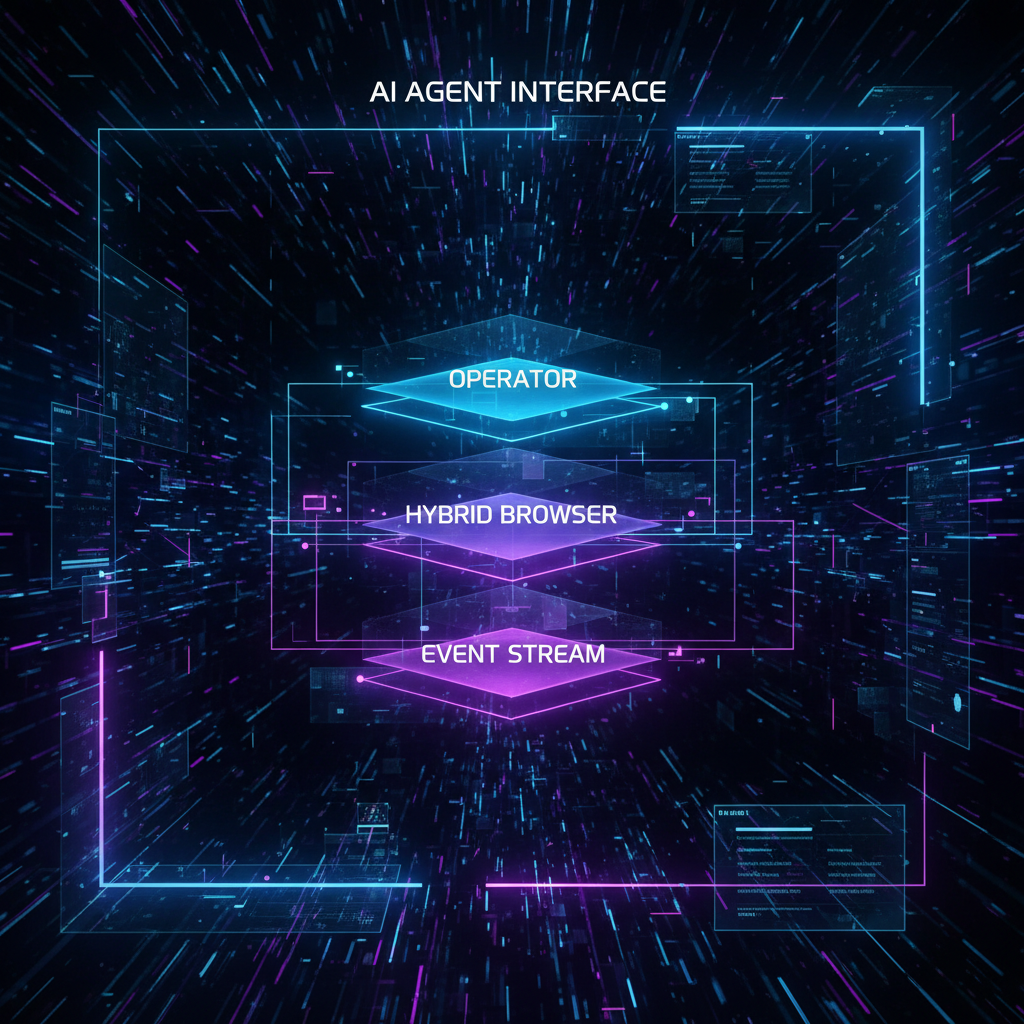
TL;DR: ByteDance’s UI-TARS ecosystem (35K★) is more than a desktop GUI agent. Its architecture reveals three transferable patterns — the Operator abstraction, hybrid GUI+DOM strategy, and Event Stream protocol — that apply to any agent stack, not just desktop automation.
Why UI-TARS Matters Beyond Desktop Agents
ByteDance shipped two things under the UI-TARS umbrella:
- UI-TARS Desktop — a native desktop app that controls your computer via vision-language models (click, type, scroll based on screenshots)
- Agent TARS CLI — a terminal-based multimodal agent that can control browsers, run shell commands, and use MCP tools
The first is interesting for automation engineers. The second is where the architecture gets interesting.
At 35.6K★ and 3.6K forks, the project has serious community traction. But the architectural patterns hidden under the packages/ directory are more valuable than the star count suggests.
Pattern 1: The Operator Abstraction
The core of @ui-tars/sdk is a generic type:
GUIAgent<T extends Operator>Where Operator is an interface with exactly two methods:
screenshot() → { base64, scaleFactor }
execute(prediction) → { status }
That’s it. The entire GUI automation pipeline — screenshot the screen, feed to model, execute the action, loop — is abstracted behind two functions. Currently there are three implementations:
| Operator | Platform | Use Case |
|---|---|---|
| NutJSOperator | Desktop (cross-platform) | Mouse, keyboard, scroll via nut.js |
| WebOperator | Browser | DOM-based automation via Playwright |
| MobileOperator | Android | Mobile UI automation via ADB |
Why this matters: The same pattern applies to any domain where you have multiple backends. Our blog empire has two platforms (Ghost via SQLite, Astro via file+git). An operator pattern would let us write platform-agnostic publish scripts:
PublishOperator
  → GhostOperator(publish via SQLite writes)
  → AstroOperator(publish via file write + git push)
The Operator pattern forces clean separation between what you’re doing and how you’re doing it. If you’re building any multi-platform agent system, steal this pattern.
Pattern 2: Hybrid Browser Strategy
Most browser automation tools pick one approach:
- DOM-based (Playwright, Puppeteer): fast, precise selectors, but breaks on shadow DOM or canvas-rendered UIs
- Vision-based (Screenshot + coordinates): works on anything visible, but slower and less precise for text input
Agent TARS supports both — plus a hybrid mode that uses DOM for text operations and vision for spatial operations.
The hybrid strategy matters because real web apps aren’t pure. A React SPA with modals, shadow DOM, and canvas elements needs both approaches. Agent TARS doesn’t ask you to choose — it detects which strategy fits the current element and switches dynamically.
For our blog empire: We already do this implicitly (SQLite direct write for speed, Ghost API for stability), but we formalize it as a fallback rather than a strategy. Pattern to steal: name the strategies, set a preference order, and let each operation pick the best path.
Pattern 3: Event Stream Protocol
This is the most transferable pattern. Agent TARS emits a structured Event Stream for every interaction:
INIT → RUNNING → RUNNING (execute) → END | MAX_LOOPEach step emits a typed event with:
data.status— the state machine statedata.conversations— delta-only messages (not full history)data.metadata— timing, token counts, errors
This differs from most agent frameworks that dump everything (raw logs, full conversation history, verbose tool output) and leave the consumer to parse it.
What makes this good:
- State-machine driven — consumers can always determine “is the agent done?” without parsing prose
- Delta-only — each event is an incremental update, not a full replay. A dashboard can append events without re-parsing the entire output
- Structured metadata — errors have error types, not just “something failed” text
In our stack: We just implemented this for our cron pipeline. Our queue drains now emit structured JSON start/end events with timing and exit codes. A dashboard can tail any cron output and know instantly: job name, when it started, when it finished, exit code, and per-item results. No regex parsing required.
The Rest of the Stack (What to Skip)
| Component | Verdict | Why |
|---|---|---|
| Electron desktop app | Skip | We don’t build desktop apps |
| nut.js desktop automation | Skip | Cross-platform mouse/keyboard irrelevant for server workloads |
| Changeset release workflow | Skip | We don’t publish npm packages |
| Husky + lint-staged | Skip | Already have pre-commit |
Bottom Line
UI-TARS-desktop is worth studying not for what it does (desktop GUI agent) but for how it’s built. Three transferable patterns:
- Operator pattern → clean separation of agent logic from backend implementation
- Hybrid strategy → dynamic fallback between approaches, not hard-coded preference
- Event Stream protocol → structured state machine output instead of raw logging
If you’re building an agent system with multiple backends, or if your cron jobs output unstructured text that needs manual parsing, these patterns save real engineering time.
UI-TARS paper: arxiv.org/abs/2501.12326
Agent TARS CLI: npx @agent-tars/cli@latest
Repository: github.com/bytedance/UI-TARS-desktop
📖 Related Reads
- ToolBrain — tool reviews, LLM comparisons, and AI workflow guides
- NoCode Insider — AI workflow automation with no-code tools, agents, and APIs
- Hermes Tutorials — Hermes Agent setup, configuration, and advanced workflows
Cross-links automatically generated from NiteAgent.
← Back to all posts