Claude Code ships 80-90% completion rates on complex tasks. Developers bet their sprints on it. Yet swap the underlying LLM to a comparable model and most users wouldn’t notice — not because models are interchangeable, but because the harness does the heavy lifting. Anthropic, Building Effective Agents
This is the most misunderstood property of AI coding agents in 2026. The industry narrative frames “better models” as the primary driver of agent effectiveness. The data tells a different story: the surrounding infrastructure — context management, tool orchestration, execution chunking, retry strategies, and protocol integration — determines output quality far more than the model parameter count.
This post breaks down what “the harness” actually does and why it matters more than the compute underneath.
What Is the AI Harness?
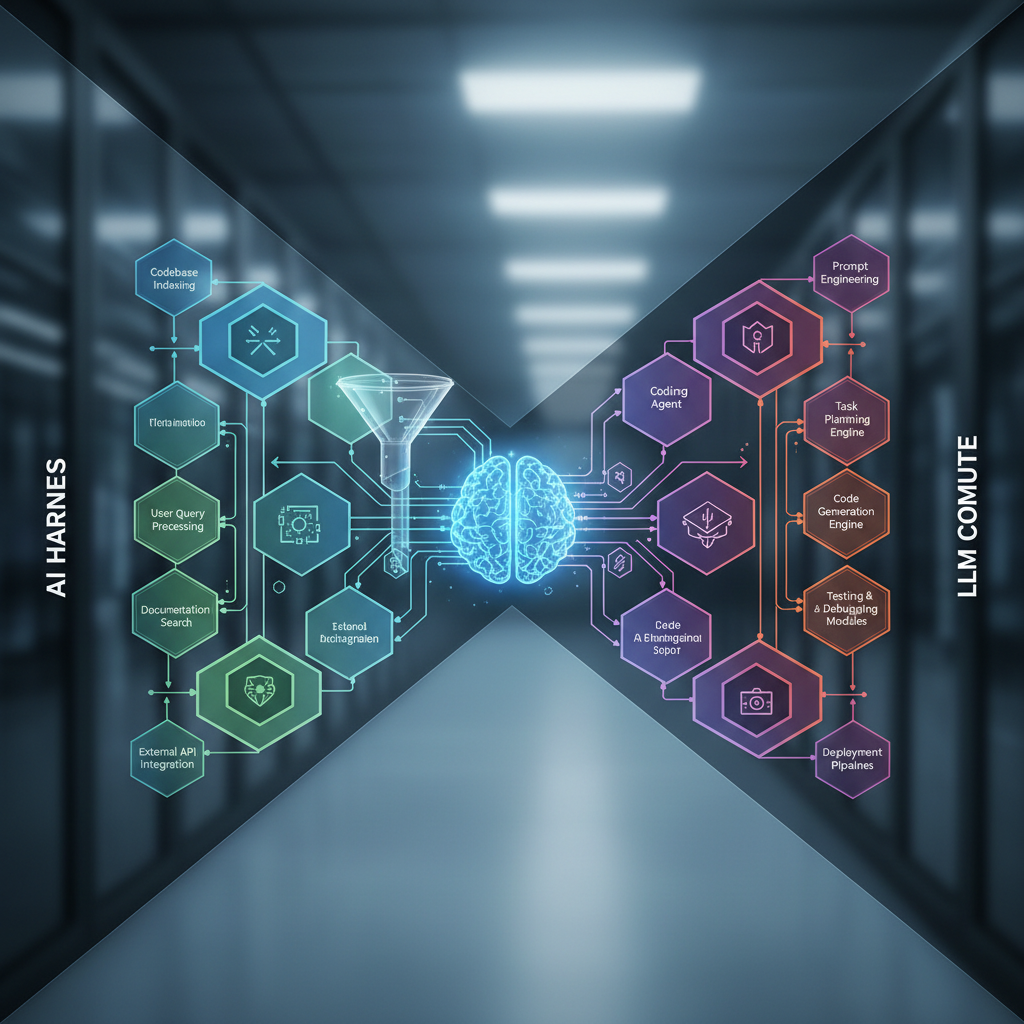
The harness is everything around the LLM call. It’s not the model — it’s the scaffolding that turns a raw text-completion API into an agentic system capable of editing files, running tests, browsing the web, and reasoning through multi-step tasks.
| Component | What It Does | Impact |
|---|---|---|
| Context optimization | Trims, prioritizes, and structures what the model sees | 2-10x effective context window |
| Tool orchestration | Routes agent intents to tools (read file, edit, search, shell) | Enables all external actions |
| Execution chunking | Breaks large tasks into model-fit pieces | Prevents mid-task model timeout |
| Diff management | Resolves edit conflicts, applies changes safely | Reliable file mutations |
| MCP protocol | Plugs in arbitrary external tools without code changes | Infinite capability expansion |
| Retry & fallback | Retries failed calls with modified context/parameters | 2-3x reliability improvement |
| Permission gating | Scopes tool access per operation | Production safety |
A coding agent without a harness is just a chat interface with a “read my repo” button. A coding agent with a good harness is Claude Code.
The Harness Does More Work Than the Model
Context Optimization
The most impactful harness component. Claude Code’s context window appears to be the model’s 200K tokens — but the harness aggressively curates what goes in.
Typical context assembly for a code change:
- User request enters the system (~100 tokens)
- Harness searches the project index for relevant files (tool call)
- Files are read and their contents structured into the prompt
- Harness strips irrelevant sections, keeps function signatures, includes surrounding context
- Previous conversation turns are summarized if window is tight
- Tool schemas are injected at the appropriate depth
The raw LLM never sees the full repository. The harness decides what matters. This curation alone accounts for more output quality than the model’s parameter count.
Source: Anthropic — Building Effective Agents
Execution Chunking
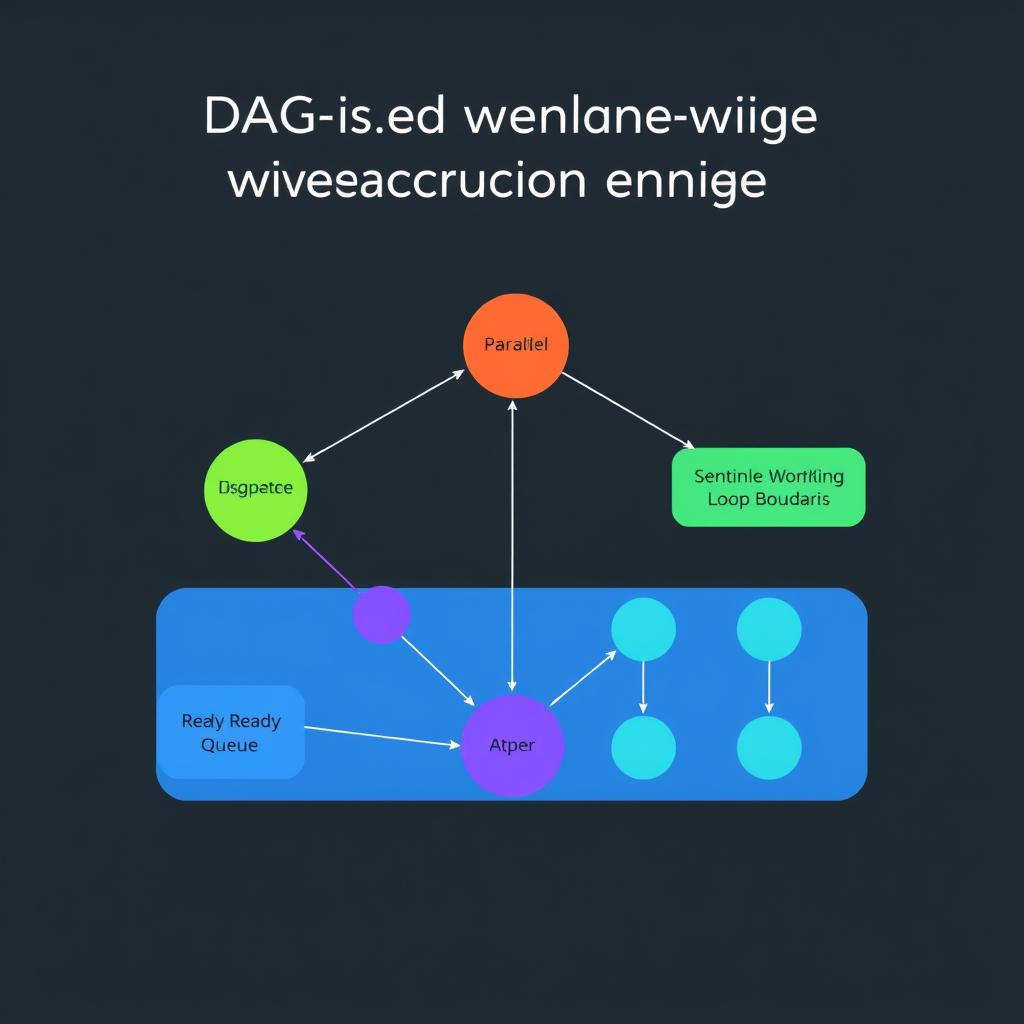
A single Claude Code session on a complex task (implement a feature across 5 files, add tests, run them, fix failures) involves 20-50+ tool calls. Each call is a fresh LLM invocation with a carefully constructed context.
The harness:
- Starts with planning — asks the model to outline the approach
- Executes the first file edit
- Detects the edit result (success, diff conflict, syntax error)
- If error: retries with the error message added to context
- Moves to next file
- After all edits: runs the test command
- If tests fail: feeds failure output back into next edit round
Each round trips through the model — but the logic of what to do next is pure harness code. The model only answers “given this file and this task, what edit makes sense?” The orchestration, sequencing, error recovery, and state tracking are all harness.
Source: Claude Code architecture overview — Anthropic
Diff Management
This is invisible to users but critical. Claude Code doesn’t ask the model to produce file contents — it asks for targeted edits (search-and-replace diffs). The harness then:
- Validates the diff applies cleanly
- Detects whitespace mismatches and fuzzy-matches the context
- Applies the edit
- Falls back to full-file rewrite if diffs fail
This pattern was pioneered in aider and Aider’s map-and-edit architecture. The model proposes edits; the harness validates and applies them. The model is the draftsman, the harness is the engineer checking the work.
Source: Aider — AI Pair Programming in Terminal
MCP Protocol Integration
MCP lets the harness attach arbitrary tool sets — databases, APIs, web scrapers, deployment pipelines — without any model retraining. The harness describes the tool in JSON Schema, the model sees it as a callable function.
The model doesn’t need to know how postgres.query() works internally. The harness handles the connection, parameter binding, error handling, and result formatting. The model just decides whether to call it and what arguments to pass.
Source: MCP Specification — Anthropic
Real-World Data: What Breaks When the Harness Fails
| Scenario | Without Harness | With Harness |
|---|---|---|
| Large file edit | Context overflow, model loses track | Chunked, partial edits with validation |
| Test-fix loop | One-shot generation, retry same output | Error-aware retry with targeted fixes |
| Multi-file refactor | Lost state across files | Cross-reference tracking, sequential edits |
| API integration | Model guesses endpoint parameters | MCP tool with verified schema |
| Permission boundaries | Model can delete production data | Tool-level gating with pre-flight checks |
The model didn’t get better between these scenarios — the harness did.
Where Compute Still Matters
None of this means the model is irrelevant. Compute matters at three specific points:
-
Reasoning quality — Complex multi-step reasoning (architecture decisions, algorithm selection) still requires model capability. A weaker model produces worse reasoning regardless of harness quality.
-
Code generation quality — The diffs the model proposes must compile, follow project conventions, and handle edge cases. Better models produce better first-draft code, reducing the retry loop.
-
Context comprehension — The model must understand the curated context. If the context surpasses the model’s effective window (even after harness trimming), quality degrades.
But these are necessary conditions, not sufficient ones. A great model with a bad harness fails. A good model with a great harness delivers reliably.
Source: LangChain State of Agent Engineering 2026 — 57.3% of production teams report harness/infrastructure as the primary bottleneck, not model capability.
What This Means for Teams
Don’t chase model upgrades as your primary quality lever
If your coding agent is producing unreliable output, the fix is probably not “switch to a better model.” It’s probably:
- Improve context curation (what does the agent see?)
- Add error recovery loops (what happens when the first attempt fails?)
- Tighten tool schemas (can the agent distinguish staging vs production?)
- Add execution chunking (is the task too big for a single pass?)
Invest in harness before model
The teams shipping reliable agents today — Clay, Vanta, LinkedIn, Cloudflare — all report that their agent infrastructure (harness, guardrails, observability) was the hard part, not the model selection.
Claude Code’s 232 skills, MCP server ecosystem, and diff-apply logic are what make it productive. Swap Sonnet for a comparable model and most of the experience holds.
Build your own harness primitives
For production systems:
- Context compositor: a module that assembles the optimal context from available data sources
- Chunk executor: breaks large tasks into model-fit pieces with state passing
- Diff applier: validates and applies edits with fuzzy matching and conflict resolution
- Tool registry: describes available tools in JSON Schema with capability gating
- Retry harness: retries with modified context on failure, escalating to human after N attempts
These are reusable across any model vendor. Invest in them once, swap models freely.
The Bottom Line
The AI coding agent market is converging on a truth that pioneers like Paul Gauthier (aider), Anthropic (Claude Code), and the MCP community have been demonstrating for months: the harness is the product, not the model.
Models commoditize. Parameter counts and benchmark scores converge. But the harness — the orchestration, context management, error recovery, and tool integration — is a compounding advantage that gets better with every task it executes.
If you’re building or buying coding agent , “Claude Code Overview](https://docs.anthropic.com/en/docs/claude-code/overview) Anthropic, “Claude Code Overview” — https://docs.anthropic.com/en/docs/claude-code/overview
← Back to all posts