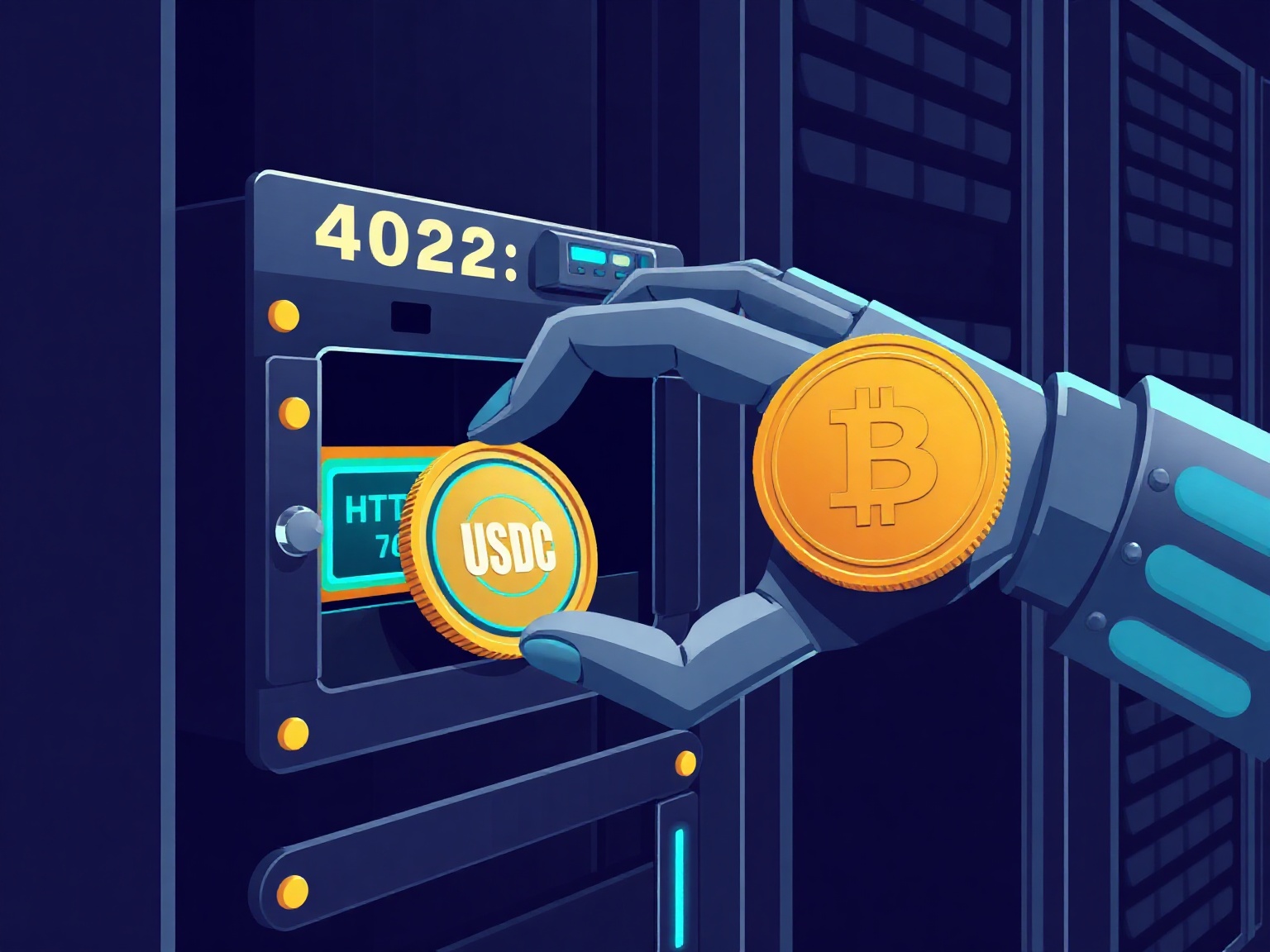
On August 5, 2026, Cloudflare opened handle reservations for Cloudflare Wallets, a programmable wallet layer built for the agentic internet [Announcing Cloudflare Wallets: The programmable wallet for the age…[Cloudflare gives AI agents wallets with built-in spending controls](. The pitch is simple: AI agents should be able to sign up for an API, pay for it, and use it — without handing the whole process back to a human. Today, agents routinely fail at exactly that. They have no stable identifier to register with, no native way to pay, and end up kicking “registration, payment methods, and API key generation back to humans” [Announcing Cloudflare Wallets: The programmable wallet for the age…. Cloudflare’s answer pairs two primitives: stablecoin wallets for agents, and x402, the HTTP-native micropayment protocol, as the rail between buyers and sellers [Announcing Cloudflare Wallets: The programmable wallet for the age…. This is the first time a major web infrastructure provider has shipped both sides of an agentic payments market, and it is worth understanding in detail.
Why agents need their own payment rails
The reason agentic payments settle on crypto instead of card networks is structural. Credit card networks were built for human commerce — every transaction assumes a human decision, a human identity, and a human dispute mechanism. AI agents transact at machine speed, without human review per call, in amounts that are often sub-cent [Agentic Payments in 2026: The x402 Explainer](. Traditional processors cannot economically process a $0.001 API call, cannot risk-underwrite a merchant whose customer is an autonomous agent, and cannot settle at HTTP speed [Agentic Payments in 2026: The x402 Explainer](.
That is the gap x402 fills. The protocol, created by Coinbase and launched in May 2025, gives HTTP status code 402 (“Payment Required”) a real meaning: when an agent hits a paywalled endpoint, the server responds with a payment requirement specifying network, token, amount, and recipient, and the agent’s wallet signs a payment intent and retries the request with proof of settlement [Agentic Payments in 2026: The x402 Explainer](. It now sits under the x402 Foundation — donated to the Linux Foundation in April 2026 — with Coinbase and Cloudflare as co-founding stewards and members including Google, Visa, Mastercard, AWS, Circle, Anthropic, and Stripe [Agentic Payments in 2026: The x402 Explainer](. The protocol settles on Base, Solana, Stellar, Arbitrum, Polygon, and Ethereum mainnet, with Base handling roughly 85% of x402 transaction volume as of April 2026 [Agentic Payments in 2026: The x402 Explainer](.
Account wallets and virtual wallets
Cloudflare Wallets come in two types [Announcing Cloudflare Wallets: The programmable wallet for the age…[Cloudflare gives AI agents wallets with built-in spending controls](:
- Account Wallets are for humans. Owners add funds, delegate spend to agents, and withdraw money when needed [Announcing Cloudflare Wallets: The programmable wallet for the age….
- Virtual Wallets are for agents and operate via API keys. Each one spends within guardrails the account owner defines — an allowance, an allow list, and a maximum transaction size — so agents can buy APIs, MCP tools, and content without a human approving every purchase [Announcing Cloudflare Wallets: The programmable wallet for the age…[Cloudflare gives AI agents wallets with built-in spending controls](.
The design philosophy is counterintuitive: caps give agents more freedom. “If an agent is responsible for $10, you can worry less about its spending than if it is responsible for $1,000,” Cloudflare argues — and if an API costs a few cents to try, $10 covers a lot of evaluation [Announcing Cloudflare Wallets: The programmable wallet for the age…. Administrators can express policy in human terms, like a $100-per-week AI inference budget per employee, and agents that hit their limit can request a manual override from an authorized human [Announcing Cloudflare Wallets: The programmable wallet for the age…[Cloudflare gives AI agents wallets with built-in spending controls](. Cloudflare also plans anomaly controls that flag unexpectedly fast spending so a human can review, approve, or stop it [Cloudflare gives AI agents wallets with built-in spending controls](.
Stablecoin self-funding
Wallets will store stablecoins, purchase services, and receive funds across the web [Announcing Cloudflare Wallets: The programmable wallet for the age…. Cloudflare says it will start with simple onramp and offramp paths in supported geographies, with self-funding via stablecoins available as an alternative for eligible users [Announcing Cloudflare Wallets: The programmable wallet for the age…. This matters because it closes the loop without a card processor: an agent can be funded in USDC, spend in USDC via x402, and its owner can top up or withdraw programmatically [Announcing Cloudflare Wallets: The programmable wallet for the age…[Cloudflare gives AI agents wallets with built-in spending controls](. On the sell side, Cloudflare’s Monetization Gateway — announced earlier in August — lets websites and apps charge micropayments for AI inference, data, and content through x402, so merchants get paid headlessly without building payment infrastructure [Announcing Cloudflare Wallets: The programmable wallet for the age…[Cloudflare gives AI agents wallets with built-in spending controls](.
Agent identity via cloudflare.pay
Payments are only half the problem; identity is the other. Cloudflare is proposing human-readable agent identifiers mapped to cryptographic keypairs, in the same way DNS maps domain names to IP addresses [Announcing Cloudflare Wallets: The programmable wallet for the age…. Handles live under cloudflare.pay — a research agent could identify itself as research.example.cloudflare.pay, letting merchants know it acts on behalf of a particular organizatFoundation [Announcing Cloudflare Wallets: The programmable wallet for the age….
The broader trend: web infrastructure becoming agent payment rails
Cloudflare Wallets is one move in a coordinated standardization wave. The Monetization Gateway plus Wallets plus identity forms what Cloudflare calls a “headless marketplace for the Internet” — and the company notes a majority of web traffic is now driven by bots, so giving agents first-class commercial tools is infrastructure work, not a side project [Announcing Cloudflare Wallets: The programmable wallet for the age…. The same week, OpenAI and four rivals — Amazon, Anysphere (Cursor), GitHub, Microsoft, and Vercel — published Agent Plugins 1.0, an open standard where a plugin is just a folder with a plugin.json at its root, bundling MCP servers and Agent Skills so one extension works across ChatGPT, Codex, Cursor, GitHub Copilot, Kiro, and VS Code [OpenAI and four rivals just agreed on one standard for AI agents](. Meanwhile, x402 was added as the first stablecoin facilitator inside Google’s Agentic Payments Protocol, letting agents on Google’s A2A network settle in stablecoins [Agentic Payments in 2026: The x402 Explainer](. The pattern: agents get standard ways to act (plugins), talk (MCP/A2A), and now pay (x402) — with identity as the connective layer [Announcing Cloudflare Wallets: The programmable wallet for the age…[Agentic Payments in 2026: The x402 Explainer]([OpenAI and four rivals just agreed on one standard for AI agents](.
The reality check on volume
The infrastructure is converging faster than the commerce. The Sherlock protocol audit team reported roughly $600 million in annualized x402 volume across all networks in its March 2026 explainer — meaningful for a protocol shipped ten months prior, but small next to the $3–5 trillion in B2C agentic commerce revenue by 2030 that Galaxy Research projects [Agentic Payments in 2026: The x402 Explainer](. RZLT’s own survey counts 165 million+ x402 transactions across 69,000 active agents by April 2026, while cautioning that roughly half of that volume appears to be testing rather than genuine commerce [Agentic Payments in 2026: The x402 Explainer](. A March 2026 CoinDesk analysis put average daily volume near $28,000 and on-chain researchers at Artemis characterized the boom as “still mostly a mirage” [Agentic Payments in 2026: The x402 Explainer](. The honest read: demand is early, but the rails are being laid by exactly the companies that control the plumbing.
The bottom line
Cloudflare Wallets matters less as a product launch than as a signal. The company that fronts a large share of the web is now running stablecoin wallets, HTTP 402 micropayments, and human-readable agent identity as core infrastructure — and it is doing it on open standards stewarded with Coinbase, Google, Visa, and Mastercard [Announcing Cloudflare Wallets: The programmable wallet for the age…[Agentic Payments in 2026: The x402 Explainer](. For practitioners, the takeaway is practical: x402 endpoints are already integrable via Node.js, Python, and Go SDKs, with a free public facilitator covering up to 1,000 transactions per month [Agentic Payments in 2026: The x402 Explainer](. The agent economy’s payment layer is being standardized now, and agents are about to get their own money.
← Back to all posts