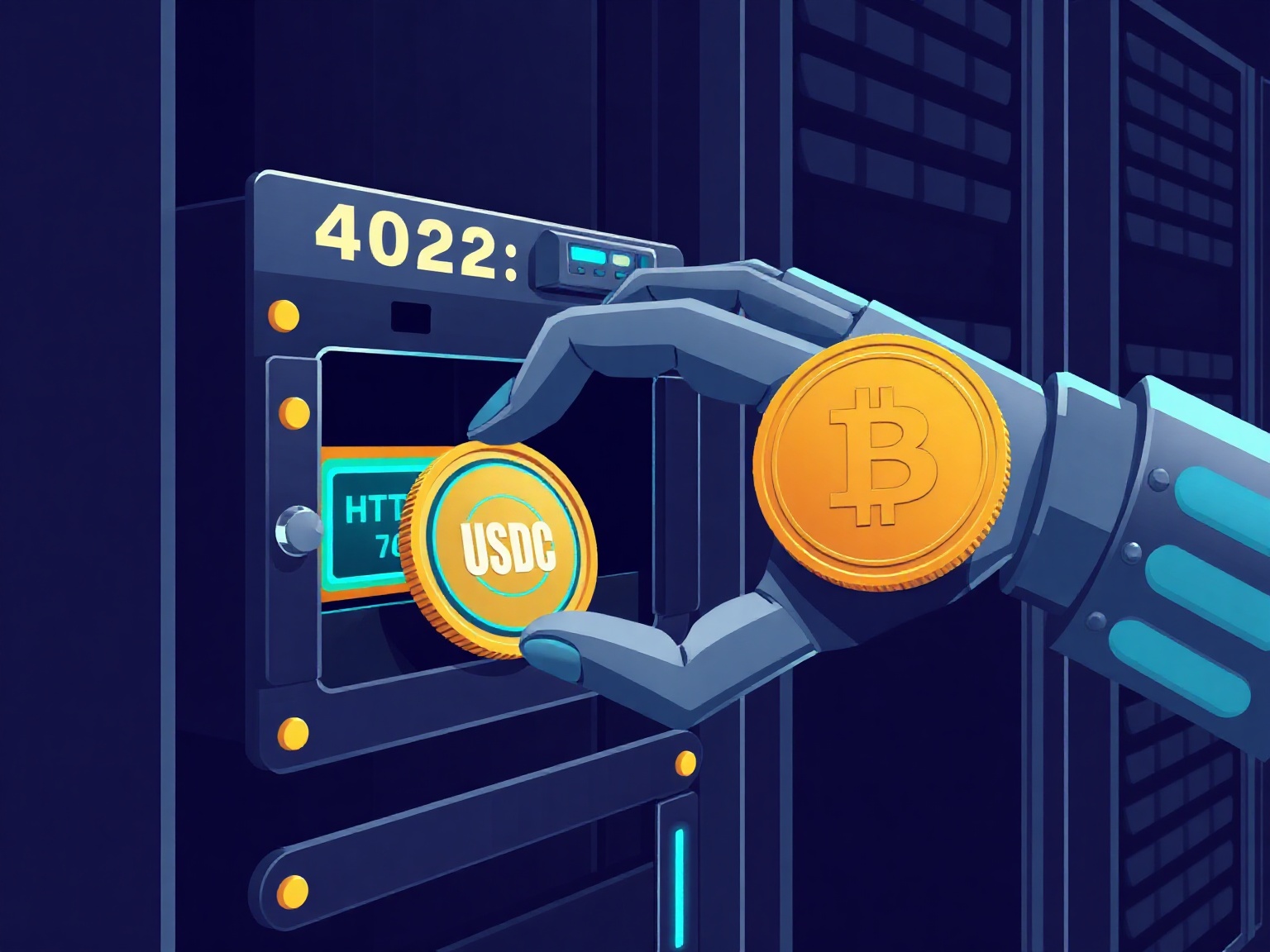
On July 26, 2026, Coinbase CEO Brian Armstrong announced that AI-to-machine transactions on Base via the x402 protocol had surpassed 100 million in just nine months. Amazon and Google are among the adopters Coinbase CEO on Agentic Finance and x402 crossing 100M AI payments…. This is not a pilot or a sandbox — it is production traffic on a permissionless L2, and it changes how we think about AI agents as economic actors.
The post goes live alongside a concurrent wave of agent-wallet infrastructure: MetaMask Agent Wallet, Coinbase Agentic Wallets, OKX, and BNB Chain all shipped within a four-week window in June–July 2026, and Mastercard launched “Agent Pay for Machines” on June 10 Every AI agent will eventually need a crypto wallet — the agent wal…. AWS partnered with Coinbase and Stripe to integrate USDC micropayments directly into Bedrock agents [AWS taps Coinbase and Stripe to power USDC payments for AI agents](. The pieces are in place. Here is how the stack actually works and what remains unsolved.
Why 100 million transactions on Base matters
Armstrong argued that crypto founders who pivoted to AI “got it backwards” — the real play is not AI startups using crypto as a gimmick, but AI agents needing crypto as their native financial layer Coinbase CEO on Agentic Finance and x402 crossing 100M AI payments…. The logic is straightforward: an AI agent cannot open a bank account, pass KYC, or hold a fiat balance. It can, however, hold a self-custodial wallet, sign messages, and pay for compute, data, or API calls in USDC over a public blockchain.
Coinbase Business now enables USDC acceptance from AI agents via x402 for more than 5,000 of its customers. The company reports that agent-generated traffic has already surpassed human traffic on its Base documentation pages Coinbase Business enables USDC acceptance from AI agents via x402. That is a leading indicator: developers building agents are the first wave, and they are consuming the stack directly.
McKinsey projects agentic commerce will reach $3–5 trillion globally by 2030 Every AI agent will eventually need a crypto wallet — the agent wal…. The 100 million transactions on Base represent the first real data point that the hockey stick may have started.
The x402 protocol: HTTP 402 for machine payments
The x402 protocol is named after HTTP status code 402 — “Payment Required” — which was reserved in the original HTTP spec but never standardized. x402 gives it a concrete meaning: when an agent hits an endpoint that requires payment, the server returns a 402 response with a charge parameter specifying the USDC amount and a destination address. The agent’s wallet parses this, constructs a transfer on Base, and retries the request with the transaction hash as proof of payment.
The choice of USDC matters. Volatile assets like ETH or BTC are impractical for machine-to-machine micropayments — an agent cannot budget accurately when the price of its payment token fluctuates 5% between quote and settlement. USDC on Base settles in roughly one second at sub-cent fees, making it viable for high-frequency, low-value transactions that would be uneconomical on L1 Ethereum.
Base specifically was chosen because it is an Ethereum L2 optimized for speed and cost. At ~0.001 USD per transfer, agents can pay per API call, per inference, or per data record without the transaction cost swamping the value of the good being purchased. The 100 million transactions in nine months imply an average of roughly 370,000 transactions per day, which Base handles without congestion at these fee levels.
The agent wallet infrastructure war
An agent wallet is fundamentally different from a human wallet. Humans need browser extensions, seed phrase recovery flows, and gas estimation UIs. Agents need JSON-RPC, programmatic signing, and bounded autonomy — the ability to authorize a wallet to spend up to X USDC per transaction without requiring human approval for every micro-payment.
The four competing approaches that shipped in June–July 2026 each take a different design:
- MetaMask Agent Wallet — CLI-first, mandatory transaction simulation, built-in Blockaid threat scanning, MEV protection, and support for nine EVM chains Every AI agent will eventually need a crypto wallet — the agent wal…. It treats security as a non-negotiable first step, running every transaction through a simulation engine before signing.
- Coinbase Agentic Wallets — natively integrated with x402 and Coinbase’s off-ramp infrastructure. The tightest coupling with the payment protocol itself Every AI agent will eventually need a crypto wallet — the agent wal….
- OKX and BNB Chain — both shipped agent wallet SDKs targeting their respective ecosystems, adding to the multi-chain reality that agent developers will face Every AI agent will eventually need a crypto wallet — the agent wal….
- Mastercard Agent Pay for Machines — the incumbent payments network entering the space, which signals that traditional financial infrastructure sees agent payments as a real market rather than a crypto niche Every AI agent will eventually need a crypto wallet — the agent wal….
For practitioners, the key architectural decision is whether to use a wallet-as-a-service (managed keys, higher throughput, custodial risk) or a self-custodial agent wallet (direct control, no third-party dependency, harder key management). The AWS + Coinbase + Stripe integration for Bedrock AgentCore Payments [AWS taps Coinbase and Stripe to power USDC payments for AI agents]( chose the managed route — agents executing USDC micropayments on Base and Solana through AWS’s managed Bedrock environment, with Coinbase handling the USDC rails and Stripe handling the fiat on/off ramps.
Open hard problems
The stack is live, but no one has solved the hard problems yet. Four stand out.
Security and bounded autonomy. An agent wallet with unlimited spending authority is a catastrophe waiting to happen — one prompt injection, one compromised model, and the wallet is drained. The MetaMask approach of mandatory simulation and threat scanning is necessary but not sufficient. The industry needs formal bounds: “agent A can spend at most 0.01 USDC per transaction, at most 100 transactions per hour, only to verified counterparties on an allowlist.” Enforcing these bounds in a way that is both flexible and provable is an open research problem.
MEV and frontrunning. Agents executing time-sensitive payments (e.g., bidding for block space, buying compute at spot price) are exposed to MEV just like human DeFi users. The MetaMask Agent Wallet includes MEV protection Every AI agent will eventually need a crypto wallet — the agent wal…. Pending authority, the attack surface expands. A compromised agent wallet on a six-hour lag-to-discovery timeline could do significant damage before a human operator can respond. Programmatic circuit breakers, rate-limited signing, and on-chain spend limits are all partial solutions that need to be composed into a coherent security model.
The bottom line
Agentic finance is not coming — it is here. 100 million on-chain transactions from AI agents in nine months, five competing agent-wallet SDKs, AWS embedding USDC micropayments into Bedrock, and a $3–5 trillion projected market by 2030 Every AI agent will eventually need a crypto wallet — the agent wallet infrastructure war. The stack — x402, USDC, Base — works today. The open problems of security, simulation, MEV, and bounded autonomy are where the next year of engineering work will be concentrated.
For developers: start simulating before you sign, set hard spending limits, and pick an L2 where the fees are lower than the value of what you are buying. The agents are already spending money. Make sure they spend it safely.
References
Coinbase CEO on Agentic Finance and x402 crossing 100M AI payments… Coinbase CEO on Agentic Finance and x402 crossing 100M AI payments on Base Coinbase Business enables USDC acceptance from AI agents via x402 Coinbase Business enables USDC acceptance from AI agents via x402 Every AI agent will eventually need a crypto wallet — the agent wal… Every AI agent will eventually need a crypto wallet — the agent wallet infrastructure war
📖 Related Reads
- ToolBrain — tool reviews, LLM comparisons, and AI workflow guides
Cross-links automatically generated from NiteAgent.
← Back to all posts