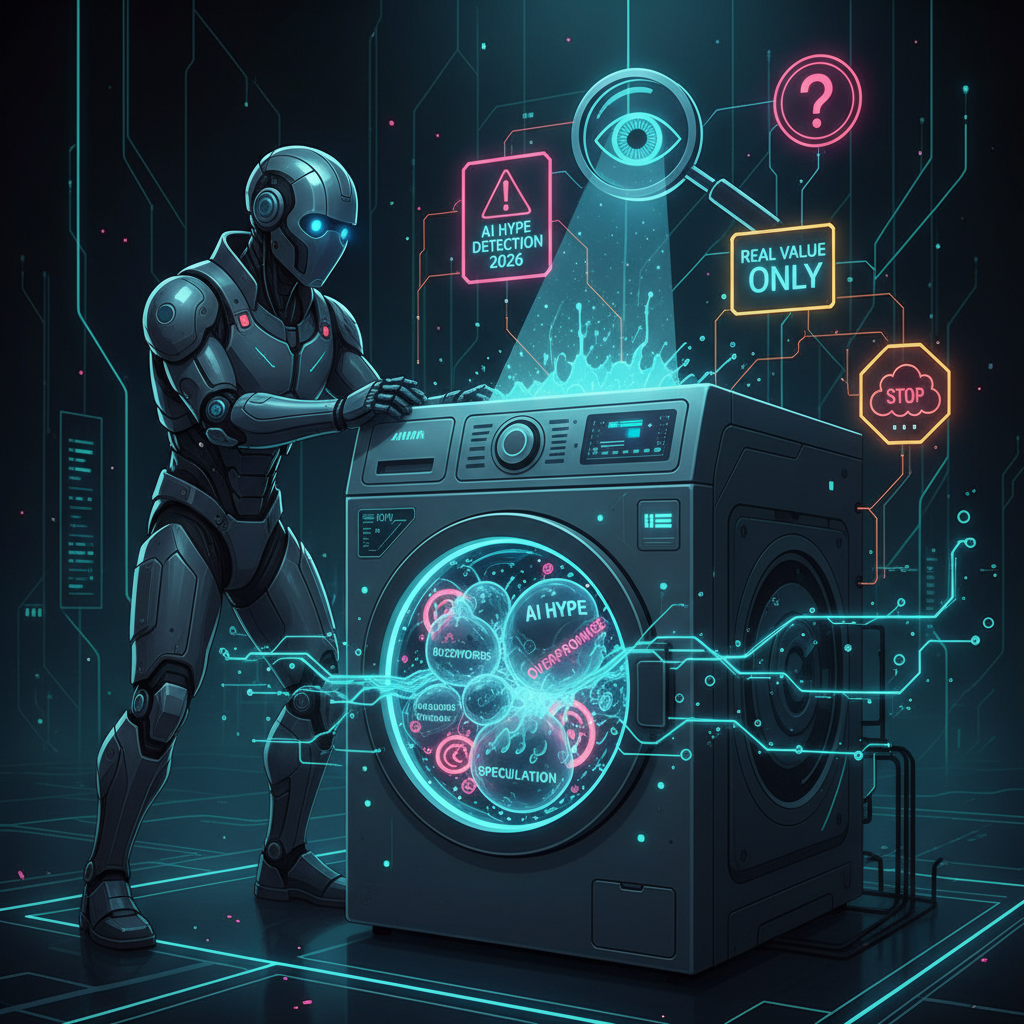
TL;DR: Gartner puts AI agent development platforms at the Peak of Inflated ExpectationsGartner, 2026 Hype Cycle for Agentic AI, April 2026.. Fewer than 130 of thousands of “AI agent” vendors are building genuinely autonomous systemsMightyBot, AI Agents Market Map 2026: Every Category Mapped, May…. Agent washing — rebranding chatbots, RPA bots, and linear workflows as AI agents — is the biggest trap for enterprise buyers in 2026. Here’s how to detect it.
The Gap Between Hype and Reality
Gartner’s first dedicated Hype Cycle for Agentic AI (April 2026) reveals a stark picture: only 17% of organizations have deployed AI agents, while 60% expect to within two yearsGartner, 2026 Hype Cycle for Agentic AI, April 2026.. That gap — the delta between expectation and execution — is where agent washing thrives.
The same report predicts >40% of agent initiatives will be cancelled by end of 2027Gartner, 2026 Hype Cycle for Agentic AI, April 2026.. Not because agents don’t work. Because teams bought something labeled “AI agent” that was actually a deterministic workflow engine with a chatbot interface.
Agent washing is when a vendor rebrands a chatbot, copilot, RPA bot, or workflow template as an AI agent without adding meaningful autonomy, tool use, memory, governance, or production observabilityMightyBot, AI Agents Market Map 2026: Every Category Mapped, May…. It’s the 2026 equivalent of 2023’s “GPT wrapper” wave — except the stakes are higher because agents act, not just answer.
Industry analysts estimate only about 130 of thousands of claimed “AI agent” vendors are building genuinely agentic systemsMightyBot, AI Agents Market Map 2026: Every Category Mapped, May…. That means presentation: none of the vendors in your procurement pipeline are shipping real agents.
The Three Flavors of Agent Washing
Every washed product falls into one of three buckets:
1. Rebranded RPA
Robotic Process Automation (UiPath, Automation Anywhere) has existed for a decade. It automates deterministic sequences: scrape this field, fill that form, click this button. In 2026, many RPA platforms added a “AI Agent” toggle that wraps their existing linear automation in an LLM prompt. The underlying execution is still a directed acyclic graph — not an agent making decisions.
How to spot: Ask for an example of the agent handling an unexpected edge case without a pre-coded rule. If the answer is “it follows the workflow,” it’s not an agent.
2. ChatGPT With Permissions
A conversational chatbot that can call a few APIs is not an AI agent. Yet most “AI agent” demos in 2026 are exactly that: a chat interface that routes to a search function, a database query, or a human handoffMightyBot, AI Agents Market Map 2026: Every Category Mapped, May…. Real agents maintain state across multi-turn execution, handle tool failures gracefully, and escalate ambiguity — not just answer questions with a button to “take action.”
How to spot: Can it execute a multi-step workflow end-to-end without a human intervening at each step? If the demo shows answering questions only, it’s a copilot — not an agent.
3. Template Linear Workflows
Tools that let you chain 5-10 pre-built blocks (n8n, Zapier, Make) are increasingly labeled “AI agent builders.” But composing a pipeline of deterministic nodes — even ones that call an LLM — is not agentic behavior. True agents make runtime decisions about which tools to call, in what order, and when to ask for help.
How to spot: Watch for “agent” being used as a label for a workflow template. If the execution path is fixed at design time, it’s not an agent.
The 8-Point Litmus Test
Borrowing from production agent engineering patternsMightyBot, AI Agents Market Map 2026: Every Category Mapped, May…, here’s the test every procured system must pass:
- Defined workflow boundary — Does the system know what it owns and doesn’t?
- Tool access with controls — Are tools documented, permissioned, logged, and limited by policy?
- Context engineering — Does it retrieve the right evidence at the right step, or dump everything into a giant prompt?
- Memory and state management — Does state survive handoffs, retries, interruptions, and human review?
- Evals and observability — Can you measure regressions, inspect traces, and improve over time?
- Human checkpoints — Does it escalate uncertainty, exceptions, and high-risk actions appropriately?
- Audit trails — Does every output link to source evidence, the policy that governed it, the model steps, and review status?
- Cost discipline — Does it avoid unnecessary reasoning loops, retries, and context replay?
If a vendor fails three or more, you’re looking at a washed product.
Why Agent Washing Is Dangerous
A bad agent pilot doesn’t just waste budget. It erodes organizational trust in the entire category. One hallucinated decision in a regulated industry can shut down the whole programMightyBot, AI Agents Market Map 2026: Every Category Mapped, May….
The data backs this up: 74% of IT leaders view AI agents as a new attack vector, and only 13% have adequate governance structures in placeGartner, 2026 Hype Cycle for Agentic AI, April 2026.. When you deploy a washed “agent” that makes an unauthorized API call or exfiltrates data through a prompt injection, it’s not the vendor’s reputation that suffers — it’s yours.
Deloitte’s 2026 State of AI report found that only one in five companies has a mature governance model for autonomous agentsDeloitte, The State of AI in the Enterprise, 2026.. The worst time to discover your “agent” is actually a deterministic script with no audit trail is during a compliance audit.
What Real Agents Look Like in 2026
The genuine agent architectures getting deployed in production share common traits:
- Multi-agent orchestration — Gartner reports a 1,445% surge in multi-agent system inquiries between Q1 2024 and Q2 2025MachineLearningMastery, 7 Agentic AI Trends to Watch in 2026.. Real agents don’t work solo; they coordinate.
- Protocol-native — MCP for tool access, A2A for inter-agent coordination, WebMCP for web access. The three-layer protocol stack is becoming the consensus architecturexpander.ai, Gartner’s Hype Cycle for Agentic AI: What It Means for….
- Bounded autonomy — Full autonomy is still not ready for most enterprise use casesGartner, 2026 Hype Cycle for Agentic AI, April 2026.. Real systems use tiered autonomy: full automation for low-stakes, supervised for moderate, human-led for high-riskMachineLearningMastery, 7 Agentic AI Trends to Watch in 2026..
- Eval-driven development — Agent pipelines are iterated through evals, not demos. Platforms with built-in evaluation frameworks (LangSmith, Weights & Biases, custom harnesses) are shipping production agents. Those without are washing.
The Signal-to-Noise Filter
As more organizations move from the 17% who’ve deployed to the 60% who intend to, agent washing will intensify. Gartner explicitly calls it outGartner, 2026 Hype Cycle for Agentic AI, April 2026.. Industry analysts warn about itMightyBot, AI Agents Market Map 2026: Every Category Mapped, May…. The market will consolidate — Gartner predicts >40% of current agent initiatives will be cancelledGartner, 2026 Hype Cycle for Agentic AI, April 2026..
The survivors won’t be the best marketed. They’ll be the ones that pass the 8-point test.
Key Takeaways
- Agent washing is the #1 procurement trap in 2026 — fewer than 130 out of thousands of vendors build real agentsMightyBot, AI Agents Market Map 2026: Every Category Mapped, May…
- Apply the 8-point litmus test before any agent procurement — if they fail 3+, it’s washed
- The three-layer protocol stack (MCP/A2A/WebMCP) is the architecture to bet onxpander.ai, Gartner’s Hype Cycle for Agentic AI: What It Means for…
- Governance is not optional — 74% of IT leaders view agents as an attack vector, only 13% are preparedGartner, 2026 Hype Cycle for Agentic AI, April 2026.
- The market will consolidate — >40% cancellation rate predictedGartner, 2026 Hype Cycle for Agentic AI, April 2026.; invest in platforms that pass the test
Gartner, 2026 Hype Cycle for Agentic AI, April 2026. Gartner, “2026 Hype Cycle for Agentic AI,” April 2026. https://www.gartner.com/en/articles/hype-cycle-for-agentic-ai MightyBot, AI Agents Market Map 2026: Every Category Mapped, May… MightyBot, “AI Agents Market Map 2026: Every Category Mapped,” May 2026. https://mightybot.ai/blog/ai-automation-agents-market-maps-gone-wild/ Deloitte, The State of AI in the Enterprise, 2026. Deloitte, “The State of AI in the Enterprise,” 2026. https://www.deloitte.com/us/en/what-we-do/capabilities/applied-artificial-intelligence/content/state-of-ai-in-the-enterprise.html MachineLearningMastery, 7 Agentic AI Trends to Watch in 2026. MachineLearningMastery, “7 Agentic AI Trends to Watch in 2026.” https://machinelearningmastery.com/7-agentic-ai-trends-to-watch-in-2026/ xpander.ai, Gartner’s Hype Cycle for Agentic AI: What It Means for… xpander.ai, “Gartner’s Hype Cycle for Agentic AI: What It Means for AI Agent Development Platforms.” https://xpander.ai/blog/gartner-hype-cycle-for-agentic-ai-what-it-means-for-ai-agent-development-platforms
📖 Related Reads
- NoCode Insider — AI workflow automation with no-code tools, agents, and APIs
Cross-links automatically generated from NiteAgent.
← Back to all posts