TL;DR: Claude Agent SDK owns OS-level agent control via MCP. OpenAI Agents SDK wins on model flexibility and sandbox execution. Google ADK dominates hierarchical multi-agent with A2A-native protocols. Here’s the side-by-side breakdown and when to pick each.
The Vendor SDK Landscape in 2026
Every major AI lab now ships a production-grade agent SDK. The question is no longer “should I use one” but “which one commits me to what.” morphllm.com
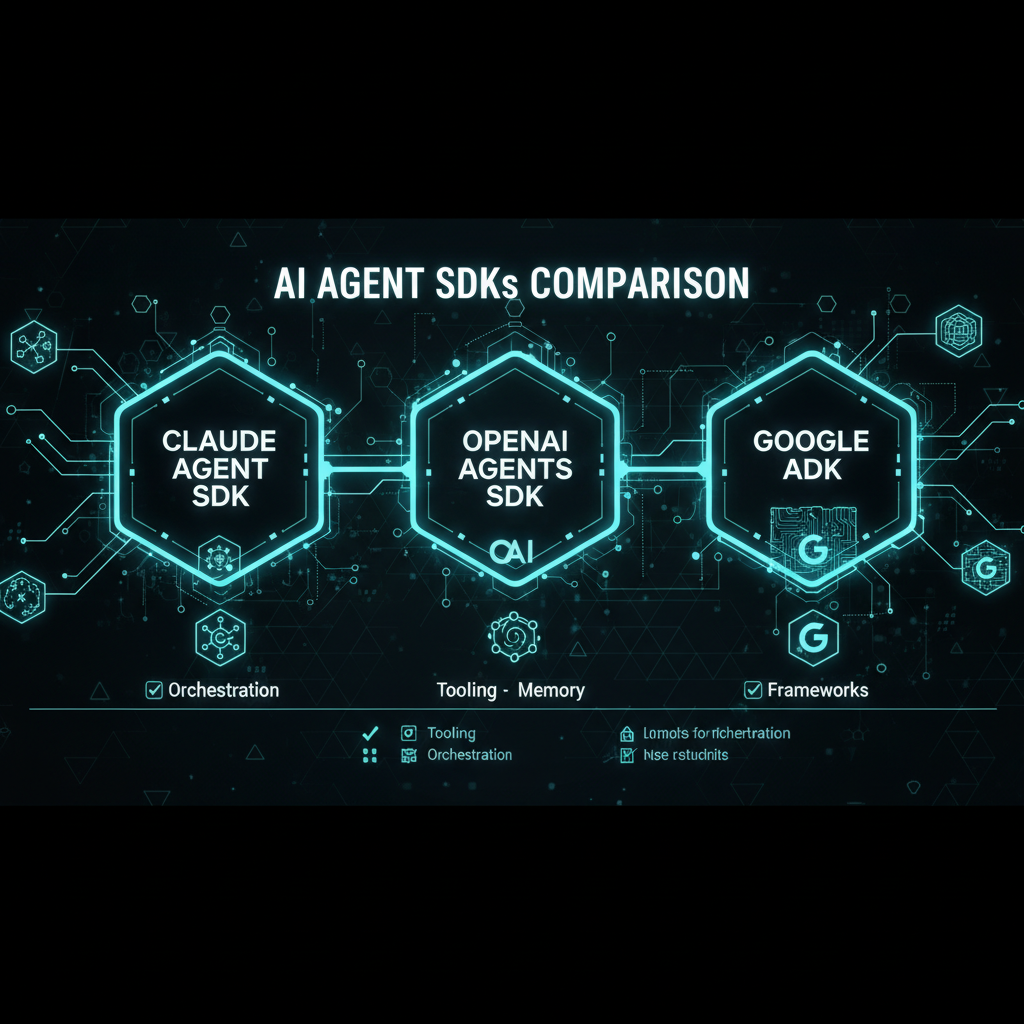
Three SDKs dominate decisions for teams building on vendor platforms:
- Claude Agent SDK (Anthropic) — rebranded from Claude Code SDK in early 2026, signaling a broader agent ambition beyond coding morphllm.com
- OpenAI Agents SDK — replaced Swarm with a production-grade framework featuring sandbox agents and harness-compute separation openai.com
- Google ADK — launched in Python, TypeScript, Java, and Go; optimized for enterprise hierarchical multi-agent systems docs.cloud.google.com
The trade-offs run deep: model lock-in, protocol support, observability, state management, and production durability all diverge sharply.
Architecture Comparison
| Dimension | Claude Agent SDK | OpenAI Agents SDK | Google ADK |
|---|---|---|---|
| Core primitive | Hooks + subagents with OS tools | Agents + handoffs (typed tool calls) | Hierarchical agent trees (supervisor/worker) |
| Multi-agent model | Subagent spawning with own context/tools | Declarative transfer_to_agent_b handoffs |
Supervisor delegates tasks via capability matching |
| LLM support | Claude only | 100+ models (OpenAI, Anthropic, Google, open-source) | Optimized for Gemini, model-agnostic in theory |
| Protocol support | MCP-native (deepest integration) | MCP adopted as additional layer | A2A-native (agent-to-agent), MCP via adapters |
| State management | Conversation rolling buffer (session-only) | Explicit pluggable adapters (Redis, PostgreSQL, filesystem) | Distributed model with eventual consistency + supervisor sync |
| Observability | Anthropic dashboard (closed) | OpenTelemetry, integrates with existing stacks | Cloud Trace + Google Cloud Operations Suite |
| Languages | Python, TypeScript | Python, TypeScript | Python, TypeScript, Java, Go |
morphllm.com Source: https://www.morphllm.com/ai-agent-framework openai.com Source: https://openai.com/index/the-next-evolution-of-the-agents-sdk/ docs.cloud.google.com Source: https://docs.cloud.google.com/gemini-enterprise-agent-platform/build/adk
Deep Dive: Claude Agent SDK
Philosophy: Give the agent a computer. Evolved directly from Claude Code, the SDK’s DNA is OS-level control — bash, file read/write, glob search, and subagents with isolated environments. composio.dev
Key strengths:
- Deepest MCP integration in any SDK — tools are first-class citizens with bidirectional communication
- Native file system and shell access — no other vendor SDK offers this
- Extended thinking for complex multi-step reasoning
- Hooks system for pre/post tool execution customization
- Context compaction for long-running sessions
Key weaknesses:
- Locked to Claude models — zero flexibility
- No A2A protocol support (agent-to-agent standards)
- State disappears on process termination (no persistence)
- Observability locked to Anthropic’s dashboard
Best for: Coding agents, research assistants, and any workflow requiring direct OS access. Teams already committed to Anthropic’s model ecosystem.
# Claude Agent SDK — research agent (concise, MCP-native)
from claude_agent_sdk import Agent, MCPTool

agent = Agent(
    model="claude-3-5-sonnet",
    tools=[
        MCPTool(name="search_docs", handler=lambda q: doc_search(q)),
        MCPTool(name="read_file", handler=lambda p: read_file(p)),
    ],
    max_context_length=200000,
    permission_mode="bypassPermissions",
)

result = await agent.run("Find best practices for React Server Components")
composio.dev Source: https://composio.dev/content/claude-agents-sdk-vs-openai-agents-sdk-vs-google-adk
Deep Dive: OpenAI Agents SDK
Philosophy: Lightweight, model-agnostic, production-grade. The April 2026 update introduced three architectural breakthroughs: sandbox agents (isolated execution environment for long-horizon tasks), harness-compute separation (control plane decoupled from execution), and broad LLM compatibility spanning 100+ models. openai.com
Key strengths:
- Model abstraction layer — switch between OpenAI, Anthropic, Google, or open-source models mid-project
- Sandbox agent execution for untrusted code
- Pluggable state management with Redis, PostgreSQL, filesystem adapters
- Built-in tracing with OpenTelemetry export
- WebSocket and SIP protocol support for real-time voice
- Three-tier guardrails (input, output, tool) running in parallel
Key weaknesses:
- No native state persistence — requires explicit adapter setup
- Linear handoff chains — no native support for complex graph topologies
- No A2A support
- Latest features (sandbox, harness, code mode) are Python-only
Best for: Multi-tenant SaaS applications, regulated environments needing data residency, teams that benchmark and swap models regularly.
# OpenAI Agents SDK — research agent (flexible, pluggable state)
from openai_agents import Agent, Tool, StateManager
from openai_agents.adapters import RedisStateAdapter

agent = Agent(
    model="gpt-5",  # Switchable to claude or gemini
    tools=[
        Tool(name="search_docs", execute=lambda q: doc_search(q)),
    ],
    state_manager=StateManager(
        adapter=RedisStateAdapter(url=env.REDIS_URL)
    ),
    guardrails=["input_safety", "output_validation"],
    system_prompt="Research agent analyzing documentation",
)

session = await agent.run(
    "Summarize React Server Components best practices",
    {"session_id": "user-123-research"}
)
openai.com Source: https://openai.com/index/the-next-evolution-of-the-agents-sdk/
Deep Dive: Google ADK
Philosophy: Engineering-grade agent development. Google ADK applies software engineering principles to agent-building — versioning, testing, modularity, and enterprise scalability. Ships in four languages. github.com
Key strengths:
- Native A2A protocol — agents auto-generate Agent Cards for cross-system discovery
- Hierarchical supervisor-worker architecture scales to complex workflows
- Visual Agent Designer for non-technical stakeholders
- Distributed state management with eventual consistency
- OpenTelemetry + Cloud Trace for observability
- Vertex AI deployment with managed infrastructure
Key weaknesses:
- Heavy GCP dependency — hard to use outside Google Cloud
- MCP support only via adapters (not native)
- Smaller community and fewer third-party integrations
- Capability matching can have routing ambiguities
- Subtle race conditions on conflicting state updates
Best for: Enterprise multi-language deployments, complex workflows decomposable into specialized sub-tasks, and organizations already invested in Google Cloud.
# Google ADK — hierarchical research agent
from google.adk import Agent, SupervisorAgent, Tool

search_agent = Agent(
    name="doc_search",
    tools=[Tool(name="search", handler=doc_search)],
    capabilities=["documentation_research"],
)

summarize_agent = Agent(
    name="summarizer",
    tools=[Tool(name="summarize", handler=summarize_text)],
    capabilities=["text_summarization"],
)

supervisor = SupervisorAgent(
    name="research_coordinator",
    workers=[search_agent, summarize_agent],
    orchestration="capability_match",
)

result = await supervisor.run("Analyze React Server Components best practices")
github.com Source: https://github.com/google/adk-python
Production Trade-offs
| Concern | Claude Agent SDK | OpenAI Agents SDK | Google ADK |
|---|---|---|---|
| Vendor lock-in | High (Anthropic only) | Low (100+ models) | Medium (GCP preferred) |
| State persistence | ❌ Session-only | ⚠️ Pluggable (setup required) | ✅ Distributed (eventual consistency) |
| Crash recovery | ❌ Starts fresh | ⚠️ Depends on adapter | ✅ Supervisor synchronizes |
| Multi-language | Python, TS | Python, TS | Python, TS, Java, Go |
| Production deployments | Anthropic internal + partners | Wide (SaaS, enterprise) | GCP enterprise customers |
| Community ecosystem | Growing (MCP servers) | Largest (200+ MCP servers morphllm.com) | Smallest |
| A2A support | ❌ | ❌ | ✅ Native |
| Sandbox execution | Via OS tools | ✅ Native sandbox agents | GCP-managed |
morphllm.com Source: https://www.morphllm.com/ai-agent-framework
Cost Considerations
Pricing differs significantly by consumption pattern:
- Claude Agent SDK: Per-token pricing plus extended thinking surcharge. Claude 3.5 Sonnet at ~$3/M input tokens, $15/M output. OS-level tools add no extra cost.
- OpenAI Agents SDK: Pay-per-model choice. GPT-5 at ~$2/M input, $10/M output. GPT-4o mini at $0.15/M input for high-volume. No SDK licensing cost.
- Google ADK: Gemini 2.0 Pro at ~$1.25/M input, $5/M output on Vertex AI (most competitive tier). ADK itself is Apache 2.0 licensed. GCP infrastructure costs extra.
For 10,000 agent runs per month at moderate complexity:
| SDK | Estimated cost (model + infra) |
|---|---|
| Claude Agent SDK | $200–$350 |
| OpenAI Agents SDK | $150–$280 (with GPT-4o mini for high-volume) |
| Google ADK | $100–$200 (Gemini on Vertex AI) |
Google ADK is consistently cheapest on model pricing. OpenAI wins on model choice flexibility at minimal premium. Claude SDK costs most per run but eliminates infrastructure for OS-level workflows.
When to Pick Each
| If you need… | Pick… |
|---|---|
| OS-level agent control (file system, shell) | Claude Agent SDK |
| Model flexibility / multi-LLM benchmarking | OpenAI Agents SDK |
| Enterprise multi-language agent system | Google ADK |
| Cross-organization agent discovery via A2A | Google ADK |
| Sandbox execution for untrusted code | OpenAI Agents SDK |
| Deepest MCP integration | Claude Agent SDK |
| Lightest learning curve | OpenAI Agents SDK |
| Cheapest per-run cost at scale | Google ADK |
The Bigger Picture: Protocols over SDKs
The real war isn’t between SDKs — it’s between protocols. MCP (Claude-native) vs A2A (Google-backed with Linux Foundation governance) determines interoperability. morphllm.com
SDKs that bet on the wrong protocol face an integration tax. Google ADK’s native A2A and adapter-based MCP gives it the widest protocol surface. Claude Agent SDK’s deepest MCP integration makes it the best tool server. OpenAI Agents SDK’s model-agnostic approach buys optionality — at the cost of protocol depth.
Teams that build for protocol flexibility now will have less migration pain in 2027. If your architecture uses A2A for inter-agent and MCP for tool access, you can swap SDKs without rewriting the entire stack.
Verdict
There is no universal winner — but the wrong choice costs months of rewrites.
- Prototype fast on OpenAI Agents SDK — model-agnostic, lowest friction, most supporting infrastructure.
- Migrate complex OS-level workflows to Claude Agent SDK — no other SDK offers what it does at the OS level.
- Go Google ADK from day one if your organization speaks Java, Go, or needs A2A-based cross-system agents.
The hardest part isn’t learning the SDK. It’s picking the one that matches your protocol future, not just your current MVP.
References
morphllm.com: https://www.morphllm.com/ai-agent-framework openai.com: https://openai.com/index/the-next-evolution-of-the-agents-sdk/ docs.cloud.google.com: https://docs.cloud.google.com/gemini-enterprise-agent-platform/build/adk composio.dev: https://composio.dev/content/claude-agents-sdk-vs-openai-agents-sdk-vs-google-adk openai.com: https://openai.com/index/the-next-evolution-of-the-agents-sdk/ github.com: https://github.com/google/adk-python jsmanifest.com: https://jsmanifest.com/claude-openai-google-agent-sdk-comparison
← Back to all posts