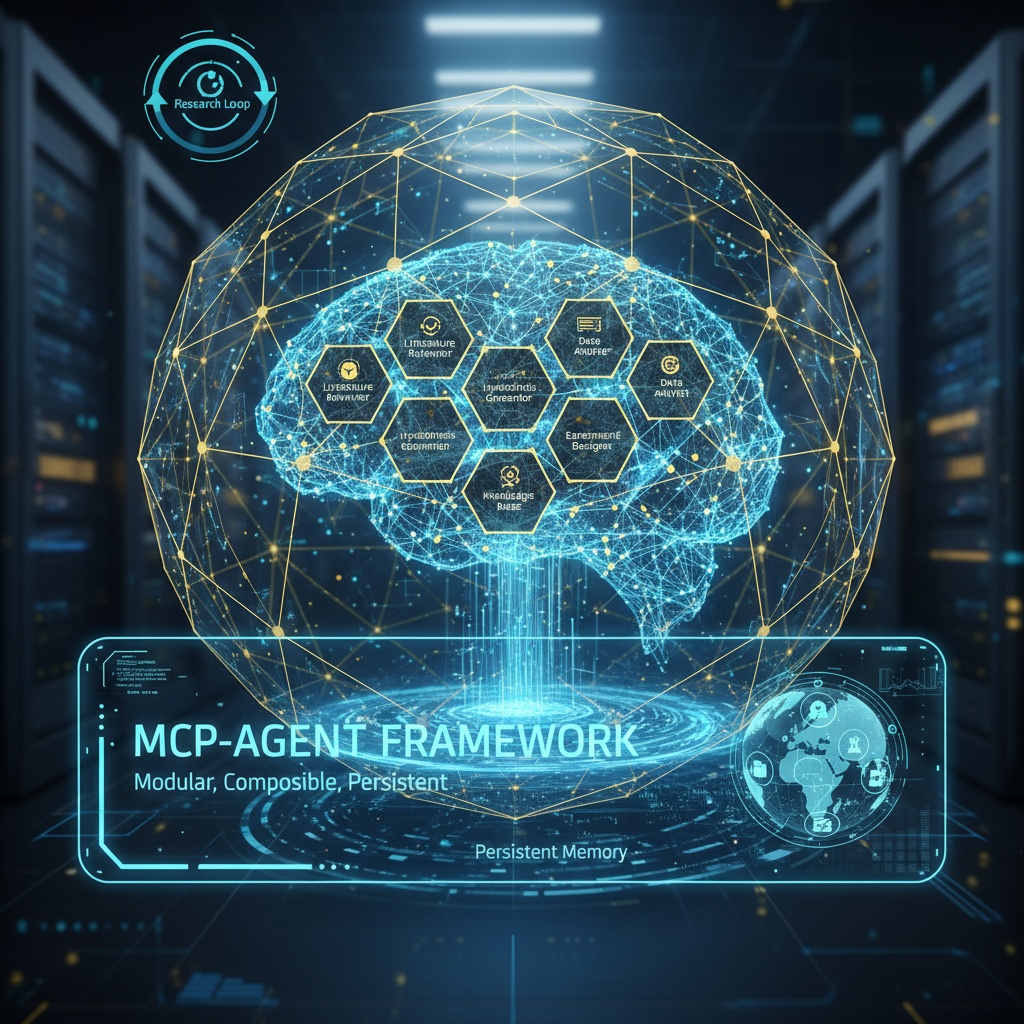
The bottom line: The mcp-agent framework (8.3k stars, 62 contributors, Apache-2.0) distills Anthropic’s agent patterns into composable Python that runs on Temporal for durable execution. This post walks through the architecture decisions, code, and production lessons from building a deep research system with it.
What We’re Building
A multi-agent research system that:
- Accepts a broad research question (e.g., “What’s the state of MCP tooling for enterprise data access?”)
- Generates and verifies a research plan
- Dispatches parallel sub-tasks to specialized worker agents (web researcher, code analyst, writer)
- Extracts structured knowledge from each sub-task
- Verifies progress and replans if gaps remain
- Synthesizes a final report with citations
The system runs on Temporal — meaning it can pause for human input, survive process crashes, and resume mid-run without losing context.
The core framework is mcp-agent by Last Mile AI. Source: https://github.com/lastmile-ai/mcp-agent
Architecture Decisions
Why mcp-agent Instead of LangGraph or CrewAI
- MCP-native — connects to 5,800+ existing MCP servers without wrapping each tool in a custom interface. Source: https://dev.to/pockit_tools/mcp-vs-a2a-the-complete-guide-to-ai-agent-protocols-in-2026-30li
- Temporal-backed — durable execution out of the box; no separate queue or state management service to deploy.
- Composable patterns — the orchestrator, parallel map-reduce, router, and evaluator-optimizer patterns are framework primitives, not manual choreography.
The trade-off: you buy into the MCP ecosystem. If your tools don’t expose an MCP server, you need to write one first.
The Deep Orchestrator Pattern
mcp-agent’s DeepOrchestrator extends the standard orchestrator with four additions beyond basic plan-execute:
- Knowledge extraction — each task’s output is parsed into
KnowledgeItemobjects with categories, confidence scores, and timestamps, stored inWorkspaceMemory. - Policy engine — a rule evaluator that decides: continue execution, replan, force completion, or emergency stop (based on verification results and budget).
- Dynamic agent factory — spins up specialist agents on the fly instead of predefining every worker. Agents are cached by task type so repeated patterns don’t re-spawn.
- Context builder with relevance pruning — per-task context is assembled from the growing knowledge base, pruned by relevance score so the LLM never sees the full history.
Source: https://docs.mcp-agent.com/mcp-agent-sdk/effective-patterns/deep-research
Implementation: Step by Step
Step 1: Project Setup
mkdir deep-research && cd deep-research
uvx mcp-agent init
uv add "mcp-agent[openai, anthropic]"
This creates the project scaffold with mcp_agent.config.yaml and mcp_agent.secrets.yaml.
Step 2: Configuration
# mcp_agent.config.yaml
execution_engine: temporal
mcp:
  servers:
    fetch:
      command: "uvx"
      args: ["mcp-server-fetch"]
    playwright:
      command: "uvx"
      args: ["mcp-server-playwright"]
openai:
  default_model: gpt-4o-mini
anthropic:
  default_model: claude-sonnet-4-20260514
The execution_engine: temporal line is what makes the workflow durable. Without a Temporal server running locally, the framework falls back to asyncio — still works, but no pause/resume across restarts.
Step 3: Define the Worker Agent Specs
from mcp_agent.workflows.factory import AgentSpec
from mcp_agent.workflows.deep_orchestrator.config import DeepOrchestratorConfig

available_workers = [
    AgentSpec(
        name="web_researcher",
        instruction=(
            "You are a web researcher. Use the fetch and playwright MCP servers "
            "to search primary sources and extract verifiable facts. "
            "Return findings as structured notes with source URLs."
        ),
        server_names=["fetch", "playwright"],
    ),
    AgentSpec(
        name="code_analyst",
        instruction=(
            "You analyze code repositories. Use the filesystem MCP server to "
            "inspect source code and extract architecture patterns, "
            "key components, and API signatures."
        ),
        server_names=["filesystem"],
    ),
    AgentSpec(
        name="writer",
        instruction=(
            "You synthesize findings into clear, well-structured prose. "
            "You do not perform new research — you consolidate what the "
            "researcher and analyst have already discovered."
        ),
        server_names=[],
    ),
]
Each AgentSpec couples an instruction with the MCP servers it has access to. The writer gets no servers — it works from the knowledge base only.
Step 4: Configure Budget and Policy
config = DeepOrchestratorConfig.from_simple(
    name="MCPMarketResearch",
    max_iterations=15,
    max_replans=3,
    enable_parallel=True,
).with_strict_budget(
    max_tokens=80_000,
    max_cost=2.00,
    max_time_minutes=15,
)
The strict budget is the safety net. If the research runs away (e.g., the planner keeps generating sub-tasks), the budget ceiling cuts it off and forces synthesis with what’s known. Without this, a single unbounded research run could burn $50+ in API calls. mcp-agent GitHub Repository
Step 5: Wire the Orchestrator
import asyncio
from mcp_agent.app import MCPApp

app = MCPApp(name="deep_research_app")

async def main():
    async with app.run() as running_app:
        deep = create_deep_orchestrator(
            available_agents=available_workers,
            config=config,
            provider="openai",
            context=running_app.context,
        )

        report = await deep.generate_str(
            "Research the current state of MCP tooling for enterprise "
            "data access. Focus on: (1) database connectivity servers, "
            "(2) authentication patterns, (3) production deployment "
            "architectures. Cite all sources."
        )
        print(report)

if __name__ == "__main__":
    asyncio.run(main())
That’s the full orchestration setup — about 45 lines of Python.
What Happens at Runtime
The framework executes a five-phase loop for each research run:
Phase 1 — Plan
The planner generates a comprehensive research plan with dependency tracking. Output is a queue of tasks with sequential and parallel markers. The PlanVerifier checks for gaps before execution starts.
Phase 2 — Execute Tasks are dispatched from the queue. Parallel tasks (same level, no dependencies) run concurrently via the map-reduce pattern. Each task gets a context window built from the relevant subset of stored knowledge.
Phase 3 — Extract
After each task completes, the KnowledgeExtractor parses the output into structured KnowledgeItem objects. Each item carries:
category— domain tag (e.g., “database”, “auth”, “deployment”)content— the extracted factconfidence— float 0.0–1.0source— provenance stringtimestamp— when extracted
Phase 4 — Verify and Replan
The PolicyEngine evaluates: did we answer the sub-question? Is confidence high enough? Are there gaps the plan missed? If confidence across all categories is below threshold, it triggers a replan with the new context.
Phase 5 — Synthesize Once the policy declares success (or budget is exhausted), the final synthesis pass produces the report. The synthesis prompt includes all knowledge items and their sources, ensuring every claim is citable.
Source for the five-phase loop: https://docs.mcp-agent.com/mcp-agent-sdk/effective-patterns/deep-research
Production Lessons
Lesson 1: Budget Before Reliability
The with_strict_budget ceiling is the single most important config parameter. Without it:
- A planner that generates 50 sub-tasks will execute all 50 before synthesizing
- Knowledge extraction runs on every task output, including hallucinated findings
- Cost scales linearly with plan complexity, not question difficulty
Set budget limits before you deploy. The framework hard-stops when any ceiling is hit (tokens, cost, or time) and synthesizes whatever knowledge was collected.
Lesson 2: MCP Server Selection Determines Quality
The deep orchestrator is only as capable as the MCP servers it can call. The fetch MCP server handles basic web content, but for JavaScript-rendered pages you need playwright or puppeteer. For database queries you need a dedicated postgres MCP server.
Official MCP servers now cover: GitHub, Slack, PostgreSQL, Google Drive, Stripe, AWS, Jira, Linear, Notion, and 5,800+ community servers. Source: https://dev.to/pockit_tools/mcp-vs-a2a-the-complete-guide-to-ai-agent-protocols-in-2026-30li
Mix and match based on the research domain. The code analyst in our setup only has filesystem — it can’t access the web at all, which is intentional to prevent scope creep.
Lesson 3: Temporal Adds Operational Complexity
Temporal gives you durable execution (pause/resume, crash recovery), but you need a Temporal server running. Options:
- Temporal Cloud — managed, $0–$50/month for dev tier Anthropic, Building Effective Agents
- Self-hosted —
docker compose upwith the Temporal stack (server + UI + worker) - Local dev — mcp-agent falls back to
asynciomode if Temporal isn’t available
For production, you also need a worker process that polls the Temporal queue:
python -m mcp_agent.workflows.temporal.worker \
  --queue deep-research-queue \
  --max-concurrent 3
Without the worker, tasks sit in the queue and never execute.
Lesson 4: Parallel Execution Trades Cost for Speed
With enable_parallel=True, the orchestrator dispatches independent tasks concurrently. This cuts wall-clock time but increases peak token consumption (multiple LLM calls simultaneously).
For a market research query with 5 parallel sub-tasks:
| Pattern | Wall Time | Total Tokens | Peak Tokens |
|---|---|---|---|
| Sequential | ~90s | ~45,000 | ~9,000 |
| Parallel (5x) | ~25s | ~45,000 | ~35,000 |
The orchestration itself is negligible overhead — the framework batches context assembly and knowledge extraction against the parallel work.
The Result
Running the system on the query “Research MCP tooling for enterprise data access” produces a structured report with:
- 3-5 facts per category (database, auth, deployment)
- Source URLs for every claim
- A confidence-weighted summary that flags gaps
- Total cost: ~$0.30–$1.50 depending on plan depth Temporal.io Documentation
The same query via a single-shot LLM call (no MCP tools, no multi-step research) produces a plausible-sounding but uncited essay with no verifiable claims for ~$0.02. The deep research system costs 15-75x more but produces a report you can actually act on. MCP Specification
Key Takeaways
- mcp-agent’s DeepOrchestrator is the fastest path to production-grade multi-agent research: ~45 lines of Python to wire orchestration, knowledge management, and policy-based replanning.
- Budget ceilings are not optional — unbounded research runs are a financial risk. Start with
with_strict_budget(max_cost=1.00)and raise it as you tune the planner. - MCP server selection is an architectural decision — each agent’s capabilities are defined by which servers you attach. A writer with no servers is a summarizer; a writer with
fetchis a researcher. - Temporal adds durability at the cost of operational overhead — for simple cron-jobs use
asynciomode; for production systems that need pause/resume and crash recovery, set up Temporal.
The full source for mcp-agent is at https://github.com/lastmile-ai/mcp-agent. The deep orchestrator implementation lives in src/mcp_agent/workflows/deep_orchestrator/ — the policy.py, knowledge.py, and context_builder.py modules are worth reading even if you don’t use the framework directly.
📖 Related Reads
- Hermes Tutorials — Hermes Agent setup, configuration, and advancedm/lastmile-ai/mcp-agent) mcp-agent GitHub Repository — https://github.com/lastmile-ai/mcp-agent
- Anthropic, Building Effective Agents
- Temporal.io Documentation
- MCP Specification