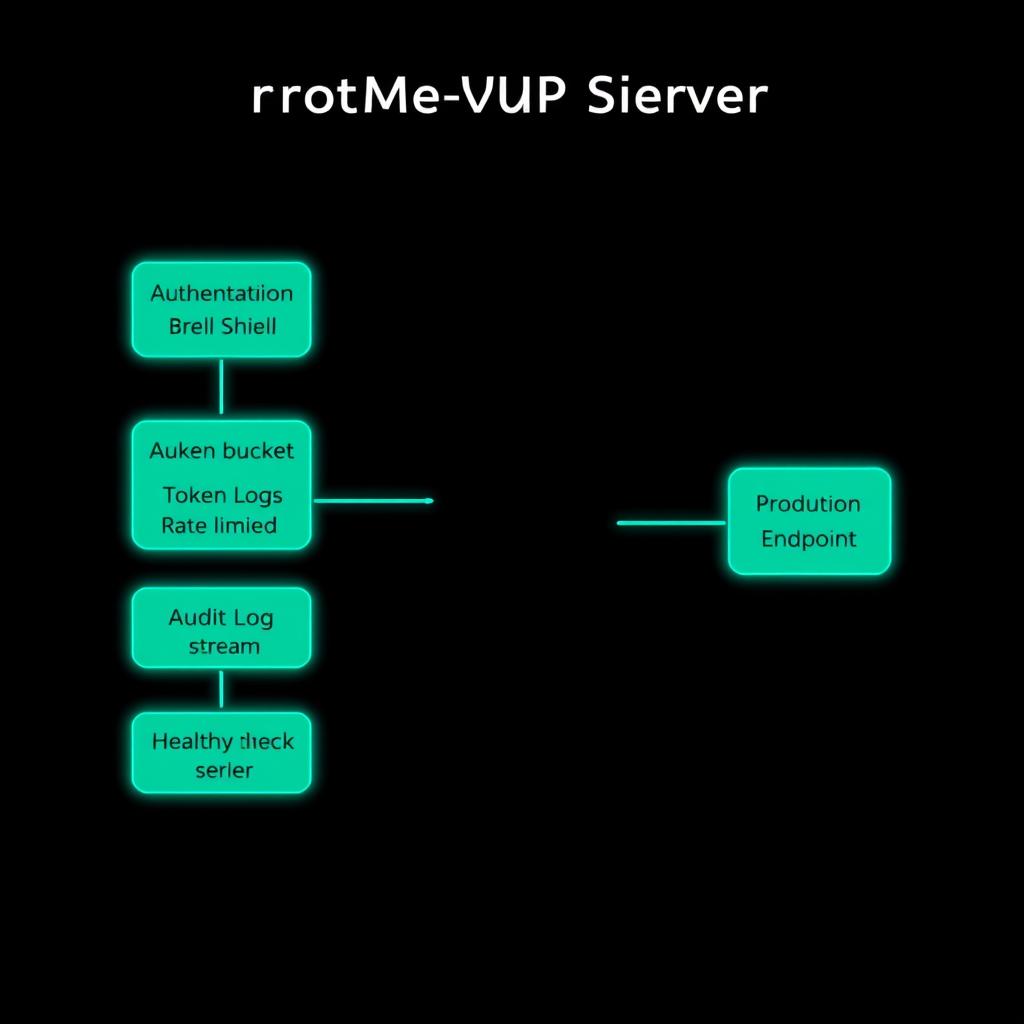
TL;DR: Most MCP server examples work great on localhost but skip everything needed for production — authentication, rate limiting, audit trails, and health checks. This guide shows how to layer all four onto a FastMCP server in 150 lines, with patterns that scale from single-server to multi-replica deployments.
The Localhost Gap
The Model Context Protocol (MCP) has 86.6k GitHub stars and reference implementations for every major language. But nearly every tutorial stops at “run it on localhost with Claude Desktop.” The reference implementations from the MCP org are explicitly “educational examples, not production-ready”. In production, an unsecured MCP server is one misconfigured agent away from unlimited API costs.
According to the MCP security spec, production servers need authentication, access control, rate limiting, and audit logging before they’re safe to expose. Here’s how to implement all four with FastMCP.
Source: GitHub — modelcontextprotocol/servers (86.6k stars, Apache 2.0) Source: MCP Specification — Security Considerations (2025-03-26)
Pattern 1: Auth Middleware for FastMCP
FastMCP added middleware support in version 2.9, letting you inject authentication, logging, and rate limiting without touching your tool handlers.
"""mcp_server_production/auth.py — API key validation middleware"""

from fastmcp.middleware import Middleware
from fastmcp.types import CallToolRequest

API_KEYS: set[str] = set() # Populate from env/config

class AuthMiddleware(Middleware[CallToolRequest, object]):
 async def before(self, request: CallToolRequest) -> None:
 key = request.metadata.get("authorization", "").removeprefix("Bearer ")
 if not key or key not in API_KEYS:
 raise PermissionError("Invalid or missing API key")
Register it:
from fastmcp import FastMCP
from auth import AuthMiddleware

mcp = FastMCP("prod-server")
mcp.add_middleware(AuthMiddleware())
Where to store keys: Environment variables for single-tenant, a database or vault service for multi-tenant. Never check them into git.
Source: FastMCP Changelog — Middleware API (v2.9)
Pattern 2: Token Bucket Rate Limiting
The MCP rate limiting guide from Fast.io recommends a token bucket as the default algorithm for MCP servers. It handles burst behavior well (agents often make rapid sequential calls like “list directory → read file”) while capping sustained throughput.
"""mcp_server_production/rate_limit.py — Token bucket per-client"""

import time
from collections import defaultdict

class TokenBucket:
 def __init__(self, capacity: float, refill_rate: float):
 self.capacity = capacity # Max burst size
 self.refill_rate = refill_rate # Tokens added per second
 self.tokens = capacity
 self.last_refill = time.monotonic()

 def allow(self) -> bool:
 now = time.monotonic()
 elapsed = now - self.last_refill
 self.tokens = min(self.capacity, self.tokens + elapsed * self.refill_rate)
 self.last_refill = now
 if self.tokens >= 1:
 self.tokens -= 1
 return True
 return False

bucket_map: dict[str, TokenBucket] = defaultdict(
 lambda: TokenBucket(capacity=10, refill_rate=2)
)

def check_rate_limit(client_id: str) -> bool:
 return bucket_map[client_id].allow()
Wire it into the auth middleware:
class ProdMiddleware(Middleware):
 async def before(self, request: CallToolRequest) -> None:
 # Auth
 key = request.metadata.get("authorization", "").removeprefix("Bearer ")
 if not key or key not in API_KEYS:
 raise PermissionError("Invalid API key")

 # Rate limit
 if not check_rate_limit(key):
 raise RateLimitError("Rate limit exceeded — try again in a few seconds")

 # Audit log
 log_tool_call(key, request.params.name, request.params.arguments)
Scaling note: In production with multiple server replicas, replace the in-memory defaultdict with Redis. The token bucket algorithm is identical — just swap the storage layer.
Source: Fast.io — MCP Server Rate Limiting: Implementation Guide for Production
Pattern 3: Audit Logging
Every MCP tool invocation should be logged with enough context to debug failures and detect abuse. At minimum:
- Client identity (API key prefix + session ID)
- Timestamp and tool name
- Input parameters (sanitized — strip secrets like passwords)
- Duration and success/failure
"""mcp_server_production/audit.py — Structured audit logger"""

import json, logging
from datetime import datetime, timezone

logger = logging.getLogger("mcp.audit")

SENSITIVE_KEYS = {"password", "token", "secret", "api_key", "authorization"}

def sanitize_params(params: dict) -> dict:
 """Strip sensitive fields from audit logs."""
 return {k: ("[REDACTED]" if k.lower() in SENSITIVE_KEYS else v)
 for k, v in params.items()}

def log_tool_call(client_id: str, tool: str, params: dict,
 duration_ms: float = 0.0, success: bool = True):
 entry = {
 "ts": datetime.now(timezone.utc).isoformat(),
 "client": client_id[:8] + "...", # prefix only
 "tool": tool,
 "params": sanitize_params(params),
 "duration_ms": round(duration_ms, 1),
 "success": success,
 }
 logger.info(json.dumps(entry))
Audit Log Retention
| Tier | Retention | Storage |
|---|---|---|
| Hot (last 7 days) | Full detail | ClickHouse / Elasticsearch |
| Warm (7-90 days) | Summarized aggregates | PostgreSQL |
| Cold (90+ days) | Rolled up by client + tool | S3 / R2 object storage |
For compliance, keep raw logs for at least 30 days. After that, aggregate daily counts by client and tool — you rarely need individual invocations from 60 days ago.
Pattern 4: Health Checks and Readiness
Agents and orchestrators need to know your MCP server is alive before routing requests. Expose standard endpoints:
"""mcp_server_production/health.py — Liveness and readiness probes"""

from fastapi import FastAPI

app = FastAPI()

@app.get("/health/live")
async def liveness():
 """Server process is running. No dependencies checked."""
 return {"status": "ok"}

@app.get("/health/ready")
async def readiness():
 """Server can accept tool calls. Dependencies verified."""
 deps = {
 "redis": check_redis(),
 "db": check_db_pool(),
 "llm": check_llm_endpoint(),
 }
 all_ok = all(deps.values())
 return {"status": "ok" if all_ok else "degraded", "dependencies": deps}
In Docker/Kubernetes: Wire /health/live as the liveness probe (simple process check) and /health/ready as the readiness probe (dependency check). Use a 5-second initial delay with 10-second intervals.
Without FastAPI: FastMCP can run standalone with SSE transport. For health checks, either embed FastAPI alongside (port separation) or add a lightweight HTTP server in a separate thread on a different port.
Putting It All Together
Here’s the full server wiring:
"""mcp_server_production/server.py — Production MCP server"""

from fastmcp import FastMCP
from .auth import ProdMiddleware
from .audit import log_tool_call

mcp = FastMCP("prod-server")
mcp.add_middleware(ProdMiddleware())

@mcp.tool()
async def search_docs(query: str, max_results: int = 5) -> list[str]:
 """Search internal documentation."""
 # Tool logic here
 return ["doc1", "doc2"]

@mcp.tool()
async def summarize_text(text: str, max_length: int = 200) -> str:
 """Summarize text using internal LLM."""
 # Tool logic here
 return "Summary..."

if __name__ == "__main__":
 # Run with HTTP+SSE transport for production
 mcp.run(transport="sse", host="0.0.0.0", port=8000)
Deployment Checklist
- API keys loaded from environment or vault, not code
- Token bucket rate limits configured per tool tier
- Audit logging with parameter sanitization
-
/health/liveand/health/readyendpoints - HTTPS termination (reverse proxy or Cloudflare)
- Timeout per tool call (default: 60s, adjust per tool)
- Tool parameter validation (max string lengths, enum whitelist)
- CORS configuration if accessed from browser-based hosts
What About Streamable HTTP?
MCP’s Streamable HTTP transport (2025-03-26 spec) replaces SSE for production use. Each request opens a fresh HTTP connection, making it compatible with standard load balancers, API gateways, and auth proxies. The auth and rate limiting patterns above work identically — just swap transport="streamable-http" in the FastMCP config.
Key Takeaways
- Auth first — Authentication is the most commonly skipped production requirement. Even internal MCP servers need API keys.
- Token bucket rate limiting handles agent burst behavior better than fixed windows. Start with capacity=10, refill_rate=2 per agent.
- Audit everything — A structured audit log with parameter sanitization is your only forensic tool when an agent goes rogue.
- Health checks matter — Expose liveness + readiness probes. Orchestrators use these to route around degraded servers.
- FastMCP middleware keeps production concerns out of tool handler logic. Use it.
The reference servers repo warns that their implementations are educational, not production-ready. That’s by design — production readiness is your job. These four patterns convert any localhost MCP server into something you can safely expose.
📖 Related Reads
- ToolBrain — tool reviews, LLM comparisons, and AI workflow guides
- Hermes Tutorials — Hermes Agent setup, configuration, and advanced workflows
Cross-links automatically generated from NiteAgent.
← Back to all posts