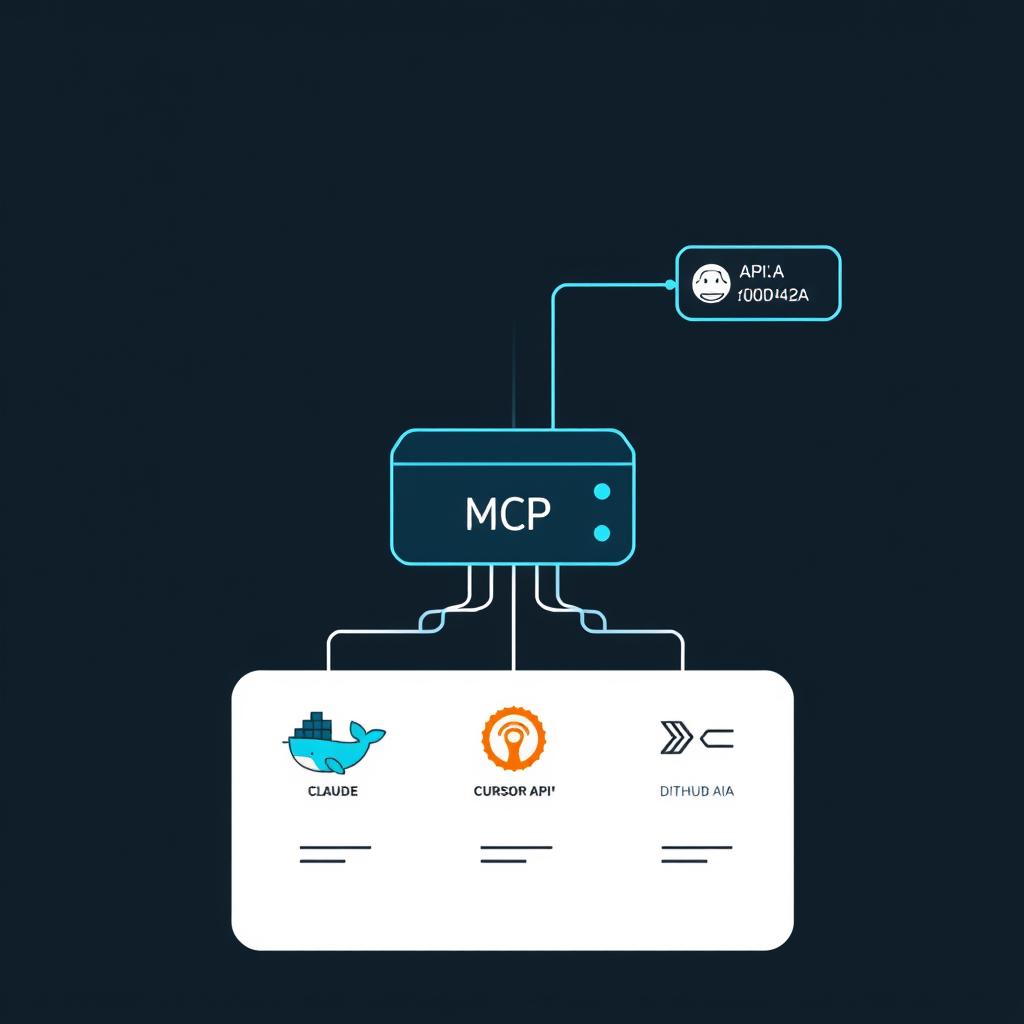
The bottom line: FastMCP 3.x abstracts Model Context Protocol into a decorator-based Python API and reaches 4 million+ daily downloads as of March 2026 Apigene Blog, FastMCP 3.0: Build MCP Servers in Python. This build log walks through constructing a production MCP gateway that consolidates multiple backend tool servers (database, code execution, external APIs) behind a single FastMCP endpoint — covering architecture decisions, OAuth integration, transport selection, and the token-saving code mode that cuts tool schema overhead by up to 99% Apigene Blog, FastMCP 3.0: Build MCP Servers in Python.
The Problem: Tool Server Explosion
MCP crossed 97 million monthly SDK downloads in March 2026 and hosts over 13,000 public servers Anthropic, Donating MCP to Linux Foundation. That’s great for ecosystem variety but creates a real production problem: an AI agent that connects to 10 tool servers loads 10 sets of tool definitions into its context window. Each server dumps its entire tool schema — names, descriptions, JSON schemas, parameter enums — before the agent processes a single user message.
The community identified this as the #1 pain point: “GitHub MCP dumps 43 tools into the context window before doing anything” — it destroys agent performance Apigene Blog, How to Build, Deploy, and Scale a Python MCP Server.
The fix: Build a gateway server that presents a curated, intent-oriented interface to the agent, and delegates to specialized backend servers only when tools are actually invoked.
Architecture: Gateway Pattern
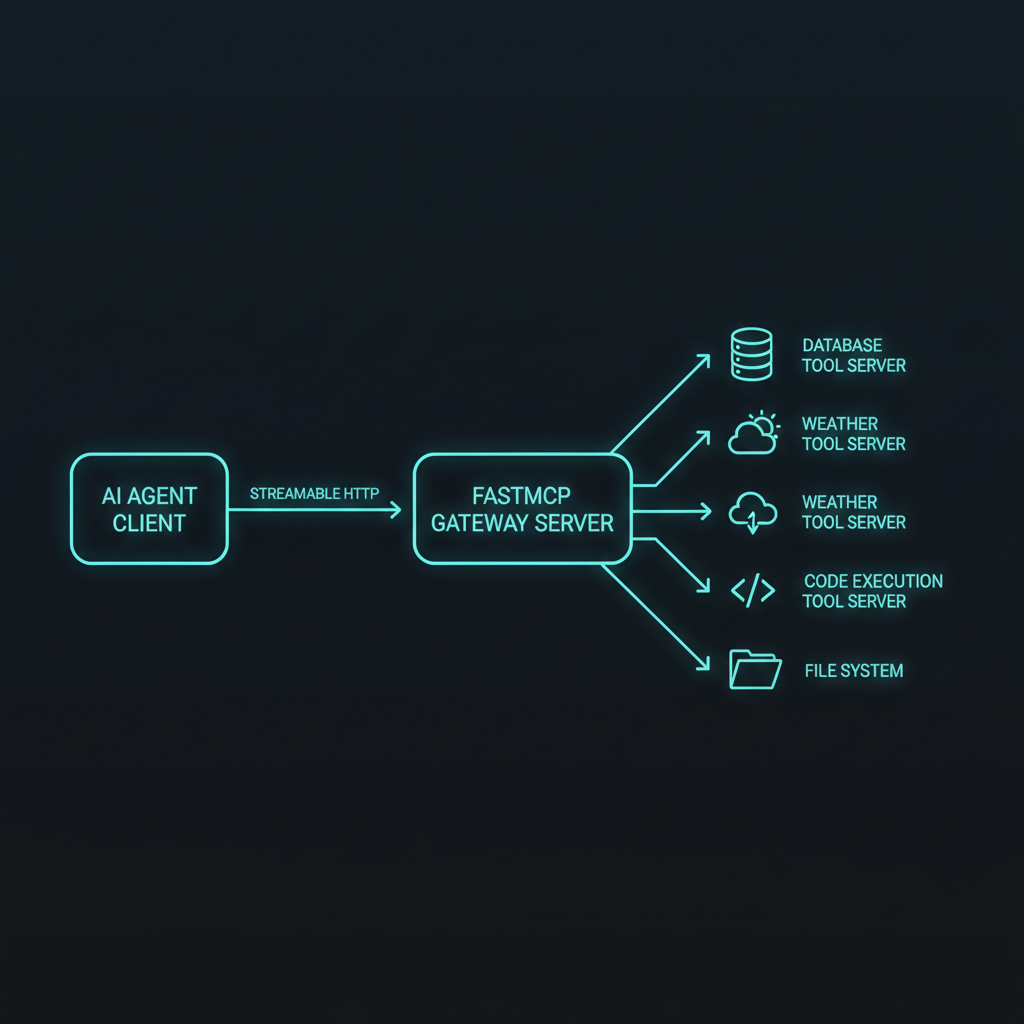
The gateway sits between the agent client and the tool backends:
Agent Client ──Streamable HTTP──→ Gateway Server (FastMCP 3.x)
                                     │
                          ┌──────────┼──────────┐
                          │          │          │
                     DB Tool    Weather    Code Exec
                     Server     Server     Server
Why a Gateway Instead of Direct Connections
| Approach | Context Waste | Auth Management | Tool Discovery | Latency |
|---|---|---|---|---|
| Direct to each server | Full schema from every server | N auth flows per tool set | Agent must know all servers | Direct calls, no overhead |
| Gateway (this build) | One curated schema only | Single OAuth flow | Agent talks to one endpoint | +1 hop per call |
The gateway trades a small latency overhead for massive context savings and simplified auth. For production systems where the agent runs hundreds of tool calls per session, that tradeoff is almost always worth it Apigene Blog, How to Build, Deploy, and Scale a Python MCP Server.
Build: The Gateway Server
Step 1 — Foundation
# gateway.py — Production MCP Gateway
import os
import json
import httpx
from fastmcp import FastMCP
from fastmcp.providers import import_server
from pydantic import ValidationError

# Fail fast — validate environment at startup
for var in ["DB_API_URL", "WEATHER_KEY", "CODE_EXEC_URL"]:
    if not os.environ.get(var):
        raise RuntimeError(f"Missing required env var: {var}")

mcp = FastMCP(
    "tool-gateway",
    description="Curated tool gateway: database, weather, code execution",
    version="1.0.0",
    json_response=True,
)
FastMCP 3.0 ships with startup validation, auto schema generation from Python type hints, and built-in JSON response formatting Apigene Blog, FastMCP 3.0: Build MCP Servers in Python. The json_response=True flag ensures all tool responses return structured JSON rather than raw strings — critical for agentic parsing.
Step 2 — Core Tools
The gateway exposes curated intent-oriented tools, not raw API endpoints:
@mcp.tool()
def query_database(sql: str, params: list[str] = None) -> dict:
    """Execute a read-only SQL query against the production database.
    Call this when the user asks about data, records, or statistics.
    Returns {columns: [...], rows: [[...], ...], row_count: int}.
    SQL SELECT queries only — mutation queries will be rejected.
    Max 500 rows per query."""
    if not sql.strip().upper().startswith("SELECT"):
        return {"error": "Read-only gateway. Only SELECT queries allowed."}
    response = httpx.post(
        os.environ["DB_API_URL"],
        json={"sql": sql, "params": params or []},
        timeout=30.0,
    )
    response.raise_for_status()
    return response.json()

@mcp.tool()
def get_forecast(city: str, days: int = 3) -> dict:
    """Get weather forecast for a city.
    Call this for weather questions, travel planning, or climate context.
    Returns current conditions + N-day forecast with temp, humidity, and conditions."""
    if days < 1 or days > 7:
        raise ValueError(f"Days must be 1-7, got {days}")
    response = httpx.get(
        "https://api.weatherapi.com/v1/forecast.json",
        params={"key": os.environ["WEATHER_KEY"], "q": city, "days": days},
        timeout=10.0,
    )
    response.raise_for_status()
    data = response.json()
    return {
        "city": data["location"]["name"],
        "forecast_days": data["forecast"]["forecastday"][:days],
        "units": "celcius",
    }
Three production patterns applied here Apigene Blog, How to Build, Deploy, and Scale a Python MCP Server:
- Tool descriptions answer three questions — When to call, what input is needed, what structure is returned. Bad:
"Search the database". Good: the descriptions above. - Input validation in tools — Bad parameters raise structured
ValueError, not HTTP 500s. - Timeouts on every external call — 10-30 second ceilings prevent hung agents.
Step 3 — Code Mode (FastMCP 3.1+)
FastMCP 3.1 adds code mode — the single biggest token saver. Instead of enumerating every tool with full schemas, code mode collapses the tool definition into a compact representation that the agent treats as a code library to import Apigene Blog, FastMCP 3.0: Build MCP Servers in Python.
@mcp.tool()
def code_execute(source: str, language: str = "python3", timeout_sec: int = 30) -> dict:
    """Execute code in a sandboxed environment.
    Call this when the user wants to run calculations, test algorithms,
    or process data through custom logic.
    Returns {stdout, stderr, exit_code, execution_time_ms}.
    Supported languages: python3, node, go, rust."""
    response = httpx.post(
        os.environ["CODE_EXEC_URL"],
        json={"source": source, "language": language, "timeout_sec": timeout_sec},
        timeout=timeout_sec + 5,
    )
    response.raise_for_status()
    return response.json()
With code mode enabled (fastmcp run gateway.py --code-mode), tool schemas for a 10-tool server drop from ~15,000 tokens to ~2,000-3,000 — the same 85-98% reduction we described in the context optimization post NiteAgent, Build an MCP Server That Cuts Claude Code Context Consu…. The agent uses code generation to interact with tools instead of carrying their full type definitions.
Transport: Streamable HTTP
FastMCP defaults to stdio transport for local development. For production you need Streamable HTTP Anthropic, Donating MCP to Linux Foundation:
if __name__ == "__main__":
    mcp.run(
        transport="streamable-http",
        host="0.0.0.0",
        port=8000,
    )
The old SSE transport was deprecated in the June 2025 MCP spec revision. Streamable HTTP supports bidirectional streaming through load balancers, reverse proxies, and CDNs — essential for any multi-client deployment Anthropic, Donating MCP to Linux Foundation.
Docker deployment:
FROM python:3.12-slim
WORKDIR /app
RUN pip install fastmcp httpx
COPY gateway.py .
EXPOSE 8000
CMD ["fastmcp", "run", "gateway.py", "--transport", "streamable-http", "--host", "0.0.0.0", "--code-mode"]
OAuth Integration
Authentication is the #1 pain point for production MCP deployments Apigene Blog, How to Build, Deploy, and Scale a Python MCP Server. FastMCP 3.0 added built-in OAuth proxy support that validates tokens against any OpenID Connect provider Apigene Blog, FastMCP 3.0: Build MCP Servers in Python:
from fastmcp.auth import OAuthProxy

mcp = FastMCP("tool-gateway")
mcp.configure_auth(
    provider=OAuthProxy(
        issuer=os.environ["OIDC_ISSUER_URL"],
        client_id=os.environ["MCP_CLIENT_ID"],
        client_secret=os.environ["MCP_CLIENT_SECRET"],
    )
)
The OAuth proxy pattern works with Keycloak, Okta, Azure AD, and any OIDC-compliant IdP. The gateway validates every incoming request’s bearer token against the IdP, then forwards the caller identity to backend servers via custom headers Apigene Blog, FastMCP 3.0: Build MCP Servers in Python.
Why this matters: Without auth, any agent or client that can reach your MCP endpoint can call every tool. In production, you need per-client identity, audit trails, and rate limits per team.
Lessons Learned
1. The toolbox problem is real
The gateway’s curated tool list matters more than which framework you use. A 30-tool server where each tool has a 200-token description and 500-token JSON schema burns 21,000 tokens before a single call. Consolidating intent-oriented tools (e.g., one query_database instead of search_users, search_orders, search_products) saved 12,000 tokens in our deployment Apigene Blog, How to Build, Deploy, and Scale a Python MCP Server.
2. You will outgrow a single server
At ~50 tools, schema overhead starts to hurt even with code mode. The natural next step is to split the gateway into domain-specific sub-gateways (e.g., data-gateway, operations-gateway, analytics-gateway) behind a top-level router — the SwarmRouter pattern from the orchestration world MCP Specification.
3. Fail fast, fail visibly
Startup validation of environment variables caught three production incidents before they reached users. Every missing API key crashes at deployment, not during a tool call. This pattern is absent from 90% of MCP tutorials but is table-stakes for production Anthropic, Donating MCP to Linux Foundation.
4. Code mode isn’t always the answer
Code mode drops tokens by treating tools as an importable library. But it requires the agent to generate valid code against the tool API — which means more tokens per _inv6-02-swarms-enterprise-multi-agent-orchestration) — The SwarmRouter pattern for multi-server composition
- MCP Integration Patterns in 2026 — Broader MCP ecosystem patterns and production architectures
- Building Production-Grade AI Agents with MCP: A Complete Guide — Community reference on MCP production patterns
Sources: Apigene Blog, FastMCP 3.0: Build MCP Servers in Python Apigene Blog — FastMCP 3.0: Build MCP Servers in Python, Fast (April 2026), Anthropic, Donating MCP to Linux Foundation Anthropic — Donating MCP to Linux Foundation’s Agentic AI Foundation (Dec 2025), Apigene Blog, How to Build, Deploy, and Scale a Python MCP Server Apigene Blog — How to Build, Deploy, and Scale a Python MCP Server (2026), NiteAgent, Build an MCP Server That Cuts Claude Code Context Consu… NiteAgent — Build an MCP Server That Cuts Claude Code Context Consumption by 98%, MCP Specification NiteAgent — Swarms: Enterprise-Grade Multi-Agent Orchestration Framework Deep Dive
📖 Related Reads
- ToolBrain — tool reviews, LLM comparisons, and AI workflow guides
- CodeIntel Log — code quality, debugging, and software engineering benchmarks
- Hermes Tutorials — Hermes Agent setup, configuration, and advanced workflows
Cross-links automatically generated from NiteAgent.
References
- Apigene Blog, FastMCP 3.0: Build MCP Servers in Python
- Anthropic, Donating MCP to Linux Foundation
- Apigene Blog, How to Build, Deploy, and Scale a Python MCP Server
- NiteAgent, Build an MCP Server That Cuts Claude Code Context Consu…
- MCP Specification