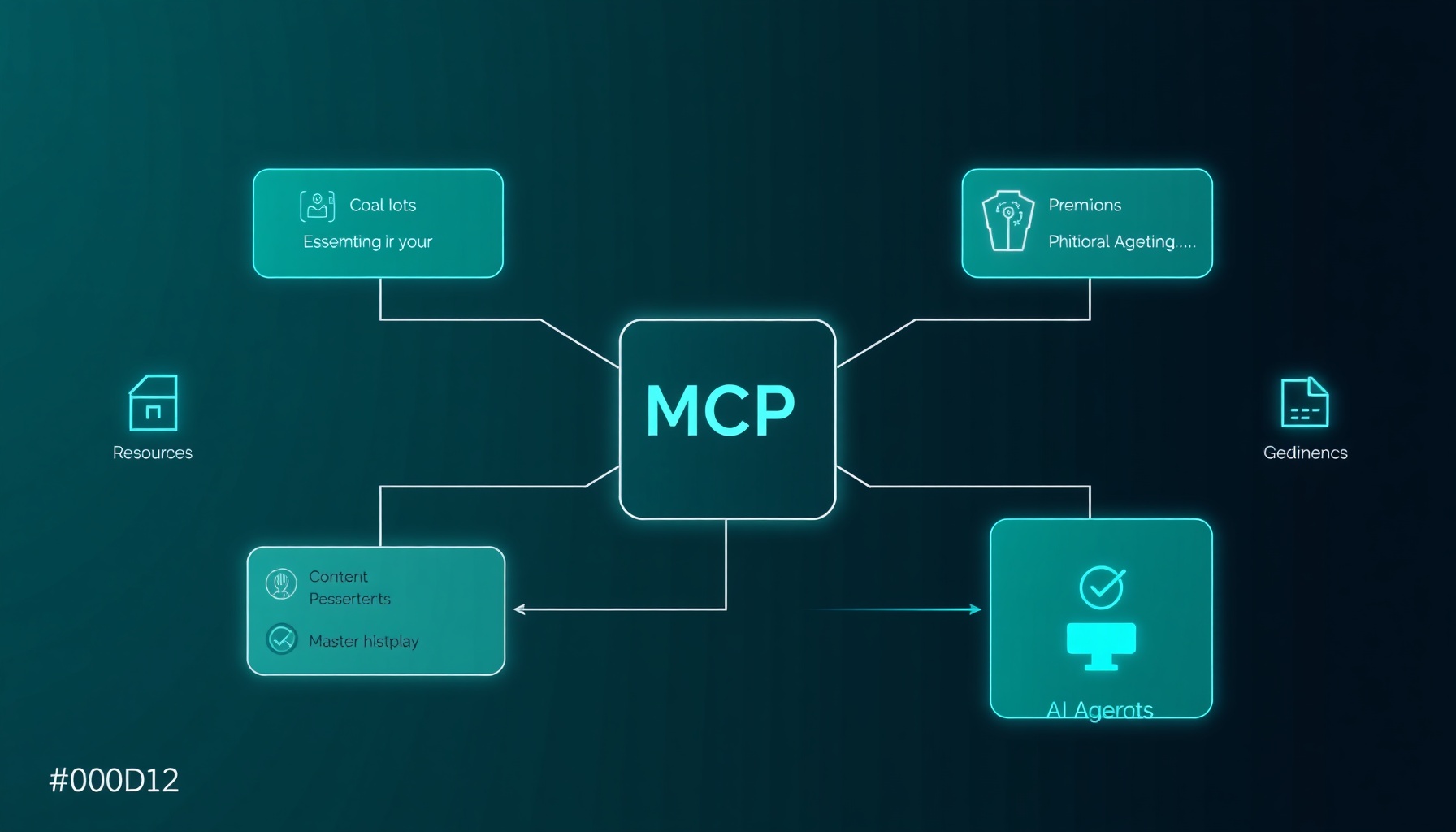
TL;DR: MCP (Model Context Protocol) hit 97M monthly SDK downloads in 2026, with 5,800+ public servers. This tutorial walks you through building your own — a document reader MCP server using Python’s FastMCP 3.0 — in under 100 lines of code. No prior MCP experience needed.
“MCP is a User Interface for AI agents.” — Philipp Schmid, huggingface
The Model Context Protocol has become the default way AI agents connect to tools and data. Every frontier lab ships client support — Claude, Gemini, Cursor, Copilot. The public server registry grew 7.8x in a single year.
But here’s the thing: the real power of MCP isn’t using someone else’s servers. It’s building your own.
When you build a custom MCP server, you decide exactly what data and operations are available to the AI. No more trying to cram your workflow into a generic tool. No more security concerns about third-party servers having access to your data.
This tutorial builds a document reader server — a server that lets AI agents read PDFs, DOCX files, images, and other documents — because it’s useful by itself and demonstrates every MCP concept you need.
What You’ll Build
By the end of this tutorial, you’ll have a running MCP server that:
- Reads PDF, DOCX, and plain text files
- Exposes a dynamic resource for recently used documents
- Provides a debugging prompt template
- Is fully testable via MCP Inspector
- Can connect to Claude Desktop, Cursor, or any MCP-compatible host
All in about 80 lines of Python.
Prerequisites
- Python 3.11+ installed
- Node.js 18+ (for MCP Inspector and testing tools)
- uv package manager (recommended, but pip works too)
# Install uv (macOS/Linux)
curl -sSf https://install.python-uv.org | bash

# Verify
uv --version
python --version
node --version
Step 1: Project Setup
mkdir mcp-document-reader
cd mcp-document-reader
uv init
uv add "fastmcp>=3.0" "markitdown[all]"
markitdown[all] is Microsoft’s document conversion library — it handles PDFs, DOCX, PPTX, images (OCR), HTML, and more. fastmcp is the Python framework that wraps the raw MCP SDK with a clean decorator API.
Step 2: Your First Server
Create server.py:
from mcp.server.fastmcp import FastMCP

# Create the server instance
mcp = FastMCP("DocumentReader")

if __name__ == "__main__":
    mcp.run()
That’s it. This is a valid MCP server. It exposes nothing, but it connects. Run it:
python server.pyYou’ll see it start and wait for connections via stdio. Hit Ctrl+C to stop.
Step 3: Add Your First Tool
Tools are functions the AI model can call. Let’s add a tool that reads text files:
from pathlib import Path

MAX_FILE_SIZE = 10 * 1024 * 1024  # 10MB

@mcp.tool()
def read_text_file(file_path: str) -> str:
    """Read the contents of a plain text file."""
    path = Path(file_path)

    if not path.exists():
        return f"Error: File not found at {file_path}"

    if path.stat().st_size > MAX_FILE_SIZE:
        return f"Error: File exceeds 10MB limit"

    try:
        return path.read_text(encoding="utf-8")
    except UnicodeDecodeError:
        return "Error: File is not valid UTF-8 text"
    except Exception as e:
        return f"Error reading file: {str(e)}"
This tool:
- Validates the file exists and isn’t too large
- Handles errors gracefully instead of crashing
- Returns a string the AI can understand and use
The @mcp.tool() decorator registers it with the FastMCP framework.
Step 4: Add Document Reading (PDF, DOCX, Images)
Now let’s add a tool that handles multiple document formats using markitdown:
from markitdown import MarkItDown

md_converter = MarkItDown()

@mcp.tool(annotations={
    "title": "Read Any Document",
    "readOnlyHint": True,
    "openWorldHint": False
})
def read_document(file_path: str) -> str:
    """Extract text content from PDF, DOCX, images, or HTML files."""
    path = Path(file_path)

    if not path.exists():
        return f"Error: File not found at {file_path}"

    if path.stat().st_size > MAX_FILE_SIZE:
        return f"Error: File exceeds 10MB limit ({path.stat().st_size / 1024 / 1024:.1f}MB)"

    allowed_exts = {".pdf", ".docx", ".doc", ".pptx", ".ppt", ".xlsx",
                    ".html", ".htm", ".jpg", ".jpeg", ".png", ".gif", ".txt"}
    if path.suffix.lower() not in allowed_exts:
        return f"Error: Unsupported format '{path.suffix}'. Supported: {', '.join(allowed_exts)}"

    try:
        result = md_converter.convert(str(path))
        text = result.text_content

        # Truncate for token budgets
        if len(text) > 50000:
            text = text[:50000] + f"\n\n[... truncated at 50,000 chars ...]"

        return text
    except Exception as e:
        return f"Error converting document: {str(e)}"
Key design choices:
readOnlyHint: True— tells the MCP client this tool doesn’t modify state- Extension whitelist — only allow known-safe file types
- 50K char truncation — prevents token overflow in the AI’s context window
- Informative error messages — the AI can act on “file not found” vs “unsupported format”
Step 5: Add a Resource
Resources are data the server controls — the AI can read them but doesn’t decide when they’re created. They’re useful for configuration, recent history, or curated reference data.
from datetime import datetime

RECENT_DOCUMENTS = []  # In production, use a real store

@mcp.resource("history://documents/recent")
def get_recent_documents() -> str:
    """Get a list of recently accessed documents."""
    if not RECENT_DOCUMENTS:
        return "No documents have been accessed yet."
    return "\n".join(
        f"{i+1}. {doc} — {timestamp}"
        for i, (doc, timestamp) in enumerate(RECENT_DOCUMENTS)
    )

# Update the read_document tool to log access
def _log_access(file_path: str):
    RECENT_DOCUMENTS.append((file_path, datetime.now().isoformat()))
    if len(RECENT_DOCUMENTS) > 20:
        RECENT_DOCUMENTS.pop(0)

# Add _log_access(file_path) to your read_document tool body
Step 6: Add a Prompt
Prompts are templates the user can invoke. They’re like macros for the AI — structured instructions for common tasks.
@mcp.prompt()
def debug_conversion(error: str, file_path: str = "") -> list:
    """Troubleshoot document conversion issues."""
    return [
        {"role": "system", "content": "You are a document conversion specialist."},
        {"role": "user", "content": f"I encountered this error: {error}\n\n"
         f"File: {file_path or 'Unknown'}\n\n"
         "Please help me diagnose and fix this issue."}
    ]
Step 7: Connect to Claude Desktop
Create claude_desktop_config.json:
{
  "mcpServers": {
    "DocumentReader": {
      "command": "uv",
      "args": ["run", "--directory", "/absolute/path/to/mcp-document-reader", "server.py"]
    }
  }
}
Place this in your Claude Desktop config (~/.config/Claude/claude_desktop_config.json on Linux, ~/Library/Application Support/Claude/ on macOS). Restart Claude Desktop. You’ll see a hammer icon — click it to see your DocumentReader tools.
Step 8: Test with MCP Inspector
FastMCP has built-in debugging via MCP Inspector:
# With FastMCP installed
uv run mcp dev server.py
# or
python -m mcp dev server.py
This opens a web UI at http://localhost:5173 where you can:
- Browse all tools, resources, and prompts
- Call tools with custom parameters
- Read resource contents
- See raw JSON-RPC messages
No more guessing what the server is doing. The Inspector shows every request and response.
Step 9: Production Hardening
Before deploying a server your team depends on, add these layers:
Path Traversal Protection
ALLOWED_DIRECTORIES = [
    Path.home() / "Documents",
    Path("/data/shared/documents"),
]

def is_safe_path(file_path: str) -> bool:
    resolved = Path(file_path).resolve()
    return any(
        str(resolved).startswith(str(allowed_dir))
        for allowed_dir in ALLOWED_DIRECTORIES
    )
Rate Limiting
from collections import defaultdict
import time

_call_counts = defaultdict(list)
MAX_CALLS = 100
WINDOW_SECONDS = 60

def check_rate_limit(user_id: str = "default") -> bool:
    now = time.time()
    window_ago = now - WINDOW_SECONDS
    _call_counts[user_id] = [t for t in _call_counts[user_id] if t > window_ago]
    if len(_call_counts[user_id]) >= MAX_CALLS:
        return False
    _call_counts[user_id].append(now)
    return True
OpenTelemetry (FastMCP 3.0)
from opentelemetry import trace
from opentelemetry.sdk.trace import TracerProvider

trace.set_tracer_provider(TracerProvider())
mcp = FastMCP("DocumentReader")
# FastMCP auto-instruments — no manual spans needed
Complete Server (All Together)
from pathlib import Path
from datetime import datetime
from mcp.server.fastmcp import FastMCP
from markitdown import MarkItDown

mcp = FastMCP("DocumentReader")
md_converter = MarkItDown()
MAX_FILE_SIZE = 10 * 1024 * 1024
ALLOWED_EXTENSIONS = {".pdf", ".docx", ".doc", ".pptx", ".ppt",
                      ".html", ".htm", ".jpg", ".jpeg", ".png", ".txt"}
RECENT_DOCUMENTS = []

@mcp.tool(annotations={"title": "Read Any Document", "readOnlyHint": True})
def read_document(file_path: str) -> str:
    """Extract text from PDF, DOCX, images, or HTML files."""
    path = Path(file_path)
    if not path.exists():
        return f"Error: File not found at {file_path}"
    if path.stat().st_size > MAX_FILE_SIZE:
        return f"Error: File exceeds 10MB limit"
    if path.suffix.lower() not in ALLOWED_EXTENSIONS:
        return f"Error: Unsupported format '{path.suffix}'"

    try:
        text = md_converter.convert(str(path)).text_content
        RECENT_DOCUMENTS.append((file_path, datetime.now().isoformat()))
        if len(RECENT_DOCUMENTS) > 20:
            RECENT_DOCUMENTS.pop(0)
        return text[:50000] if len(text) > 50000 else text
    except Exception as e:
        return f"Error: {str(e)}"

@mcp.resource("history://documents/recent")
def get_recent() -> str:
    if not RECENT_DOCUMENTS:
        return "No documents accessed yet."
    return "\n".join(f"{i+1}. {d} — {t}" for i, (d, t) in enumerate(RECENT_DOCUMENTS))

@mcp.prompt()
def debug_conversion(error: str) -> list:
    return [
        {"role": "system", "content": "You are a document conversion specialist."},
        {"role": "user", "content": f"I got this error: {error}\nPlease diagnose."}
    ]

if __name__ == "__main__":
    mcp.run()
72 lines. That’s your production-ready MCP server.
What’s Next?
This document reader is a foundation. From here you can:
| Enhancement | Why |
|---|---|
| Add authentication | @mcp.tool(auth=lambda ctx: ctx.user.role == "admin") |
| Version your tools | @mcp.tool(version="2.0") with backward compat |
| Add search | Expose vector search over your document corpus |
| Deploy remotely | Wrap with SSE transport instead of stdio |
| Write tests | Use MCPClient for integration tests in CI |
The key insight is this: MCP servers are just Python functions with JSON Schema contracts. You don’t need to change your business logic. You write a thin layer that maps your existing code to tool definitions, and suddenly every MCP-compatible AI can use it.
Further Reading
- Firecrawl FastMCP Tutorial — deeper dive into FastMCP 3.0 features
- MCP Best Practices by Philipp Schmid — “MCP is a UI for agents”
- MCP Cheat Sheet 2026 — quick reference for all protocol primitives
- MCP Integration Patterns — related patterns for production MCP
- Claude Agent SDK Tutorial — building agents that consume MCP servers
Want to go deeper? Check out the MCP specification and the FastMCP docs.
best-practices) MCP Best Practices by Philipp Schmid MCP Cheat Sheet 2026 MCP Cheat Sheet 2026
← Back to all posts